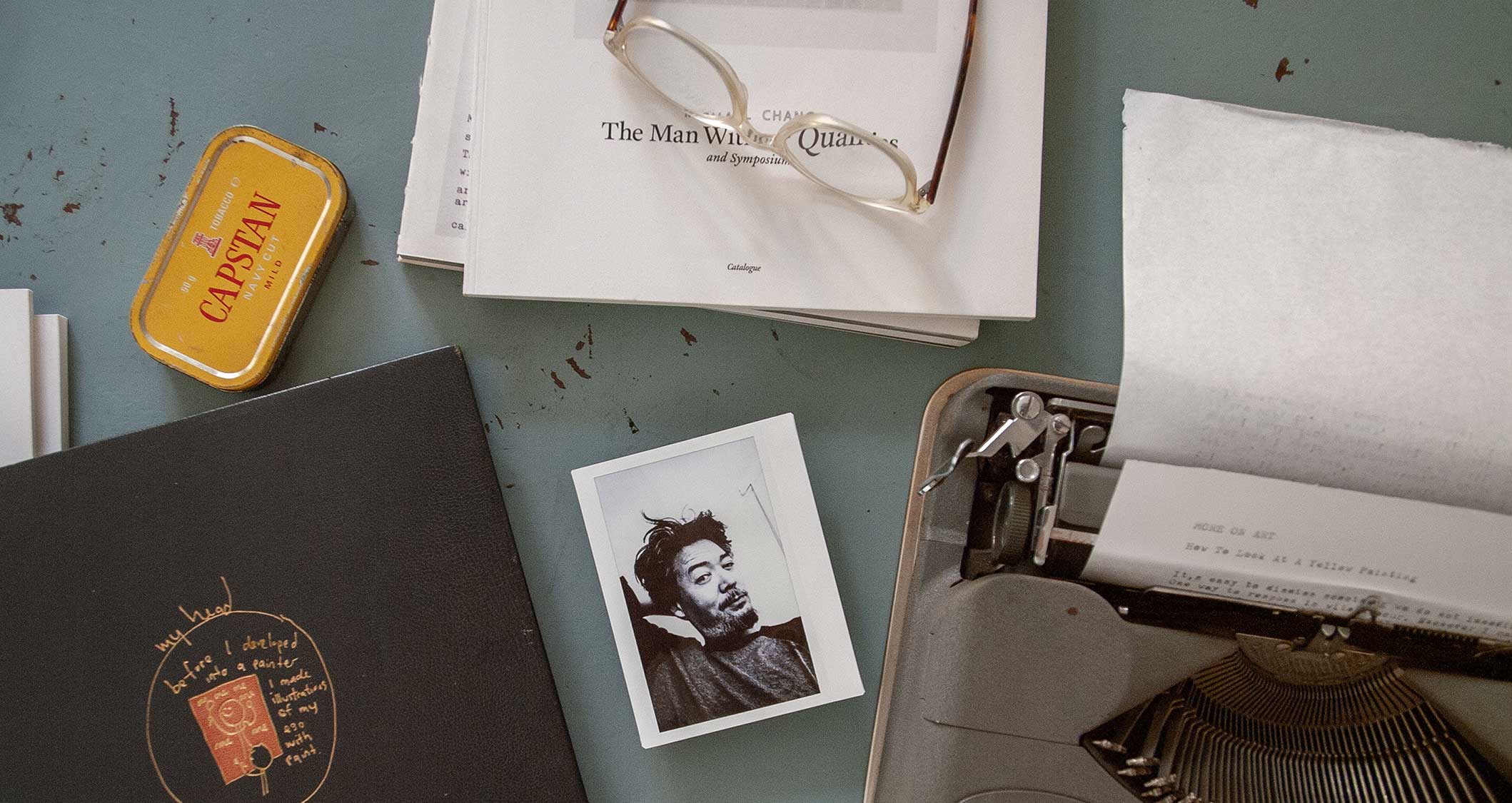
About this collection.
These essays examine painting as a mode of thinking rather than solely a mode of image-making. Drawing on studio practice, sketchbooks, material processes and examples from art history, they explore questions of visual language, authorship, biography, abstraction and meaning.

More on Art

Armchair travels into contemporary abstract painting

TABLE OF CONTENTS

FOREWORD

Shortly after I began showing my paintings in 2008, I began writing about my work. From 2010 to 2013 I wrote letters of correspondence to two of my colleagues and friends: Marty McCutcheon and Jan Kather. The letters are now arranged chronologically in A Collection Of Essays On Art, available on michaelchang.dk. Twelve years later, in 2025, I decided to write about my work as a painter again.

A famous maxim attributed to musical comedian Martin Mull reads: 'Writing about music is like dancing about architecture.' The origins of the quote have never been verified—the maxim is also attributed to the likes of musicians, entertainers, and writers such as William S. Burroughs, Miles Davis, Thelonious Monk, Charles Mingus, Frank Zappa, George Carlin, Lester Bangs, David Byrne, Steve Martin, Elvis Costello, and Laurie Anderson. – Why take up writing again? What is the purpose of dancing about architecture?

In a post on substack.com, written by a friend of mine, there is a quote that reads, 'Writing is thinking.' To write well is to think clearly. That’s why it’s so hard. My friend on Substack attributes this quote to Paul Graham, a programmer, writer, and investor who holds a PhD in Computer Science from Harvard and studied painting at RISD and the Accademia di Belle Arti in Florence. One reason for me to start writing again would be to get back to thinking – and sharing my thoughts. It is my intention to dance as clearly as I can about my work in these new essays.

On Collecting Souvenirs From the Past and Greek Vases in Museums

Published: Gråbrødretorv, Copenhagen, September 28, 2025

I am a collector by nature, and I like keeping souvenirs from the past. I have to be careful not to gather too many empty glass jars, stones from beaches, or bits of wood that might someday prove useful for building something. Recently (Summer 2025), I redesigned my website, shifting from what a friend once called “a literary feel” to a short, video-clip–based experience. The intention was to create a first-person view, a more intimate connection with past exhibitions. With the exception of my debut, I am fortunate to have video footage spanning from The Man Without Qualities (2010, Danneskiold-Samsøe Gallery) to Graphite (2022, Galleri Weinberger Schandorff).

In 2007, just before the financial crisis, I decided to stop painting figuratively and begin making monochromes. The first videos on my site show footage from 2008 and 2009—me working in two different studios, painting in a reduced, monochromatic manner. I added subtitles to the clips describing this shift from figuration to abstraction. The text begins, a little dramatically: “The most difficult time for me as an artist was December 2007…”

…when I ruined my last figurative painting. Something inside me wanted to destroy what I had just created. Not because I didn't like the painting, but because I liked it too much. I was in love with being talented… and I didn’t like that feeling. So I painted a dark brown colour over that painting. And then I felt a very strong feeling of regret. I cursed myself. I really, cursed myself for destroying that painting. I thought, 'I’d quit painting, never paint again.' For three days… I quit being a painter. I remember this strange feeling of regret. What was going on? Why did I destroy the best painting I'd ever made? What on earth made me do that? Then it began to make sense. Imagine how liberating it is to work as an artist and NOT care about being talented. I began to paint monochromatic paintings. I used my body as a scale and my proportions as measurements for all my paintings and drawings. I made up rules, and I used numbers as guidelines. I became a “dogme” painter… and, in a way, an abstract painter.

The art world has never been stable. Shifts and upheavals are the norm. As an artist, I never know if, where, or when I will be able to exhibit again. When I had my first solo show in 2010, I naively thought: “I’ve made it!” A few shows later, I understood the importance of patience and documentation. In 2025, there is upheaval once again: veteran galleries are closing, while new platforms such as Artsy.net bring art online.

Veteran gallerist Tim Blum announces closure of his physical spaces.

”In an interview with ArtNews, Blum said the decision was less about the current art market and more “about the system.” Blum described the gallery’s participation at Art Basel last month as a “thunderclap—confirmation of everything I’ve been feeling for years,” referring to a growing dissatisfaction with the expanding infrastructure of contemporary gallery life, including constant art fairs, openings, and administrative obligations.” — Artsy.net

I am now in my early fifties. My walking shoes are well worn, and my pace has slowed from sprinting, to jogging, to simply taking my time. What matters is to keep working, whatever the upheaval. In my experience, most obstacles originate in thought: ideas about talent, about success. I had to learn that ambition should be directed inward, as motivation. Ambition about the work itself—not the response to it. Mental gymnastics are necessary to overcome hardship and resistance. Since my debut in 2008, I’ve shifted my goal: from overturning the art world to simply creating something meaningful for the small audience my work touches. Success, I’ve learned, can be measured within the studio.

Artistically, the decisive change in 2007 was to stop painting figures and begin asking: How can rules and restrictions act as catalysts for new ideas, new ways of seeing, new ways of working? By refusing to make recognisable images, I had to turn my attention to other aspects of painting. The tactile quality of paint became my foothold in this new territory, leading to years of experimentation with materials. Chalk remains a favourite. So do beeswax and graphite. Every pigment has its own personality. Colours behave like children at play, restless in the light. Two colours act as lovers; add a third and you have a family. Add more, and you are building a family tree. Before long, you are writing novels with these characters—novels about relationships across generations, like the best of stories.

In painting monochromes, I realised how essential layers are. Each layer holds a moment in time. Looking at the strata in a painting feels like time travel—akin to stargazing, where the light we see has travelled for years before reaching us. By 2025, layering has become my way of working. I imitate historians and conservators: wall restorers in museums leave behind tiny squares of paint layers, a discreet record of colour histories. Tree rings mark decades of growth and pause. In my studio, I alternate between reading about painting techniques and conducting trial-and-error experiments. I use eggs in my work—egg white as a glue, yolk as an emulsifier binding oil and water into paint. The technique aims at both a pleasing result and stability.

I will never know if I succeed. The true scale for durability is the Greek vases in museums, thousands of years old. I wish I could watch my oil paint grow brittle, see colours gradually become more transparent. But in the end, none of that matters as much as the fervour—the drive to keep making.

Chestnut Fall

Published: Gråbrødretorv, Copenhagen, September 29, 2025

I sit on a bench by the lakes in Copenhagen, eating Clara Frijs pears.
I listen to Star Eyes by Charlie Parker.
I am fifty-one years old as I write this poem in Notes on an iPhone 13.
Time passes.
And when one day I reread this poem, I will no longer be the same.
Who will I be?

I watch life pass by my bench.
I see ages.
I see the man I was in my forties in a couple pushing a pram.
I see the man I was in my thirties in a woman out running.
I see the man I was in my twenties in a young lad carrying a shopping bag from Normal.
I see the boy I was in my teens in two girlfriends watching a younger girl stand on the stone wall that runs along the lakes in Copenhagen, stretching up for chestnuts on a chestnut tree.
Chestnut fall.

I see myself in my sixties in a man with a dog.
I see myself in my seventies in a woman with white hair.
I see.
Myself.
In my fifties.
In this poem.
Sitting by the lakes in Copenhagen, eating Clara Frijs pears, listening to Duke Ellington play Sophisticated Lady, take 2.
A poem, finished.

What Is A Dogme Painter?

Published: Gråbrødretorv, Copenhagen, June 19, 2026

After I left figurative painting in 2007 and began working with rules in my practice, I also started writing letters about my work. In a correspondence with my dear friend Jan Kather, she responded to my description of these rules with the phrase, “So, you are a Dogme painter!” At the time I didn’t fully realise how right she was. Only recently have I come to see how precisely the term describes the way I work — especially when set alongside the more established label of abstract painter. Since then, I have become attentive to other Dogme artists. I use the terms 'Dogme artist' and 'Dogme painter' as a tribute to the Dogme 95 film movement, in which filmmakers agreed to strict guidelines in order to spark new forms of creativity. In painting, the Dogme painter adapts the same principles: self-imposed rules as a foundation for discovery.

Dogme painter definition

A Dogme painter can be defined as: “An artist who establishes self-imposed rules for the painting process, while using both adherence and transgression of those rules as part of artistic expression.” This definition highlights the balance between structure and freedom — the central paradox of Dogme-painting.

Dogme painting rules

The rules of Dogme-painting vary from artist to artist, but the structure is always deliberate. Common approaches include: * Inventing rules: deciding on restrictions for subject matter, materials, colour palettes, brushwork, or process. * Honouring rules: exploring the creative possibilities that arise when limits are respected. * Breaking rules: treating each departure from the system as a meaningful artistic choice. By framing the process this way, Dogme-painters transform rules into a stage for experimentation.

Why dogme painting matters

Rules have helped shape art history — from the strict geometry of Renaissance perspective to the radical reductions of Minimalism. A Dogme painter continues this lineage, not necessarily through a collective manifesto, but through personal ones. These systems are never fixed; they can evolve, dissolve, or reform with each new work. Such a practice often brings dilemmas that demand meaningful responses. By narrowing choices, the painter encounters the unexpected — solutions and images that could not have been planned. In this way, Dogme painting shows how limitation can open new directions, revealing paths that might otherwise remain hidden.

Examples of using rules in art practice

Sol LeWitt, "Lines, Not Straight, Not Touching, Four Colours", 1971.
Hanne Darboven. Untitled (FILM… I.). c. 1970.
Yutaka Matsuzawa, "Peep into the Psi Tortoise, the Winged Secret Rules from The Whole Works", 1962.
Victoria Chang’s poem “On a Clear Day” In proper layout after Agnes Martin. Untitled from On a Clear Day. 1973.
Lee Ufan, "From Line", 1974 Mineral pigment on glue on canvas.

When rules like these are broken, the act itself becomes charged with meaning — an intentional gesture that adds another layer of expression.

Other artists across time have turned to rules as a vehicle for making. Sol LeWitt’s Lines, Not Straight, Not Touching, Four Colours (1971) is a system executed with strict instructions, yet yielding unpredictable visual rhythms. Hanne Darboven’s Untitled (FILM… I.) (c. 1970) translates time and repetition into serial notations, rules unfolding across the page. Yutaka Matsuzawa’s Peep into the Psi Tortoise, the Winged Secret Rules from The Whole Works (1962) takes rules into the conceptual and mystical, proposing art as an invisible structure. Victoria Chang’s poem On a Clear Day, written after Agnes Martin’s Untitled from On a Clear Day (1973), follows the grid and spacing of Martin’s work, letting the visual form dictate the rhythm of the poem. Lee Ufan’s From Line (1974), with its repeated brushstrokes fading out across the canvas, demonstrates how a simple, rule-based gesture can open a space of meditative attention.

These works, among others, demonstrate how rules can serve as a vehicle for exploration and discovery. In a similar spirit, I use the term Dogme-painter to describe one way of working: a practice in which rules are acknowledged, followed, and sometimes bent or broken, allowing the process itself to generate meaning. The term is offered not as a definition of art, but as a concept to articulate a particular method — one that already exists in the gestures, procedures, and choices of many artists.

Conclusion: The philosophy of Dogme-painting

A Dogme-painter is not bound by an external school or manifesto, but by self-chosen boundaries. This makes Dogme-painting less a style and more an attitude: a practice that thrives on the tension between rules and rebellion. For artists and viewers alike, Dogme-painting offers a way to reimagine painting as both a game of discipline and a space of freedom.

The use of rules and constraints belongs to a much wider artistic current. Surrealist painters devised the exquisite corpse, where each participant contributed without seeing the others’ parts, creating works structured by both restriction and chance. The Beat poets experimented with cut-up techniques, slicing and reassembling sentences to let procedure shape the poem. Minimalist and Conceptual artists adopted systems and serial methods, embracing limitation as a way of opening unforeseen possibilities.

In this context, the Dogme 95 film movement can be seen as part of the same spirit: rules not as obstacles but as instruments, setting the stage for discovery.

It was against this backdrop that my friend Jan Kather, in a letter exchange, first called me a Dogme-painter. I had described to her how I use my own body as a ruler in my work — a method that is at once useful and poetic, because the measuring tool is always close at hand. A brushstroke painted in proportion to my body — 184 cm tall and 54 cm wide — can be perceived at a scale of 1:1. A painting at human scale defines space much as a person defines a room.

We instinctively measure the world in relation to our bodies. In a photograph, the presence of a figure immediately establishes scale and proportion. An apple is small; a mountain is large. Water is wet, iron is hard and can be both cold or hot to the touch, glass is transparent. Our sense of the world is embodied, and my practice makes this principle explicit: the body becomes both rule and ruler, a standard against which painting can unfold.

How To Watch Paint Dry

Published: Gråbrødretorv, Copenhagen, June 23, 2026

“Writing is thinking. To write well is to think clearly. That’s why it’s so hard.” — Paul Graham. The same can be said about painting. Painting is thinking. To paint well is to think clearly.

Learning the craft of painting allows you to avoid common problems such as cracking, sagging canvas, rot, crumbling, and delamination. But painting well can be difficult for reasons that have little to do with craft.

This essay explores the coherence between the concerns that occupy me as a painter and the thinking that unfolds in my sketchbooks.

Crayons and paper

I grew up in a home filled with crayons and paper. My mother is a trained technical draughtsperson, and from an early age I was encouraged to draw.

Watching my own children write stories and make illustrations together allowed me to observe how they influenced one another as they developed a visual language.

When my oldest daughter was a teenager, she was influenced by Japanese cartoons. But as she gradually developed a style of her own, only loosely based on Manga, she was criticised by her peers.

It makes you wonder whether there are conventions in children’s drawings. A sun in the corner? Stick figures? Short arms and oversized heads? Mermaids? A lack of perspective? Sparse detail? Colouring outside the outlines?

Applied to children’s drawings, conventions of style seem strangely limiting. Would you correct a child for placing the sun in the centre of the lower half of the picture plane? Or would you find it intriguing and ask why?

As a parent, I would prefer children’s drawings to remain limitless and free from convention. When I compare my children’s early intuitive mark-making with their later learned forms of expression, style is simply not the whole picture. There are no right or wrong children’s drawings; only different stages of development and different choices being made.

Likewise, recognisable styles make artworks easier to categorise and discuss. But reducing images to questions of right and wrong is a limited way of understanding what they do.

In the documentary My Kid Could Paint That, there is a scene in which four-year-old Marla paints on a large canvas. Her father has stretched the canvas, decided its scale, and provided his daughter with paint and brushes. The scene suggests that artistic meaning emerges from choices made before the first mark appears.

The function of style is to shape perception. Instead of asking whether Marla is an artist, we should ask how she is an artist. Because she is guided by her father’s knowledge of painting and art history, that too is part of how Marla becomes an artist.

Rather than simply transmitting information, images engage our imagination. They construct a reality not only through visual means but also through intention.

The meaning of an artwork is inseparable from its material embodiment. We use our bodies to sense the world around us. A painting speaks through colour, form, and brushwork, and also through whether we perceive it as large or small, tall or wide, dry or glossy, old or newly made, sharp or rounded. Our understanding of form, shape, and material is rooted in the way we experience our own bodies.

Technical and formal questions are central to my own artistic practice. Yet formal constraints are more than decorative devices. They generate meaning beyond structure, composition, and repetition. They give rise to questions that are not immediately present on the surface.

What makes a painting modern if its style is contemporary while its rectangular format and painting techniques are ancient? And more curiously, how are form and meaning connected?

Art as a career?

When I watch the documentary about the four-year-old artist, I cannot help adding meaning to her story.

Did she paint all the works herself? Beyond stretching the canvas, how much did her father contribute? How much of the process is collaboration? Is it a shared production? What were the motives? Who benefits from the attention? Who pays for the art? What role does the gallerist play? How much influence does Marla have over which paintings are exhibited?

It is reasonable to look for answers in the conditions under which art is produced. It is equally natural to look beyond the artist alone in order to engage with the work. Evaluation becomes a social event. Categorising artworks and passing judgement on style can be understood as ways of distributing authorship; not over the making of the artwork, but over the meanings we attach to it.

As such, the relationship between form and meaning remains open-ended. Even when artists collaborate in making a work, they have little control over what it will come to mean for its audience.

Curators, art foundations, gallerists, art historians, colleagues, museums, collectors, patrons, and the general public all contribute their own interpretations. So, what does it mean to pursue art as a career?

Models of authorship

In Ovid’s Metamorphoses there is a cautionary tale about choosing art as a profession. The story of Arachne and Athena illustrates how authority is negotiated during a contest between a talented artist and the goddess of wisdom, warfare, and handicraft. As an artist, you are always up against dominant narratives in a struggle over authorship. External forces continually seek to define what your work means and, like Arachne, risk reducing you to a spider endlessly spinning its web.

In my own experience, artistic thought develops through a web of support and dialogue rather than through individual brilliance, let alone the myth of the solitary (usually male) genius. Rather than gods awakening our senses, animating our bodies, or transforming us into spiders, it is often family members who encourage us to draw; siblings who shape our sense of taste; correspondence with friends and colleagues that informs our understanding of a work.

All these collaborators challenge hierarchical models of authorship by participating in the making of meaning. Artistic thought is shared. It develops through dialogue, collaboration, and role models.

It is difficult to think of anything that enters the world alone. History holds its sway over the present and, no matter how hard we try, we never gain complete autonomy over our work.

Nicolas Poussin’s Blind Orion Searching for the Rising Sun (1658) suggests that we do not make our journey alone. Orion has been blinded by Oenopion, the legendary king of Chios. In Poussin’s painting there is a tiny but significant detail: the servant Cedalion stands upon Orion’s shoulders, helping the giant hunter find his way.

When we look at paintings, we do not look with our eyes alone. We look with everything we have experienced, and with everything that came before the particular painting before us.

Can visual language be separated from cultural upbringing? Are paintings autonomous objects, or are they shaped by the identity of their maker? Is it possible to look at my work and ignore my Korean and Danish heritage? How does biography provide a foundation for what we see?

There is something reassuring in the fact that we cannot escape what came before us.

Every generation wants to enter the world with an open mind and make experiences for itself. In 2011 I copied, reproduced, deconstructed, reconstructed, dissolved, wrote upon, and almost eliminated images by Paul Cézanne, Andy Warhol, Edvard Munch, Francis Bacon, and Francisco Goya. It was by no means an expression of aversion.

One of the paintings I appropriated was the painting Puberty by Edvard Munch. Rather than fleeing from the awkward uncertainty of not yet knowing, there is value in the process of becoming. Almost eliminating, dissolving, deconstructing, and reconstructing a visual language can itself become a powerful way of learning.

Reading visual languages

If there is coherence between my essays and my sketchbooks, it is rooted in language.

My essays and my sketches have developed simultaneously, side by side, over decades. Together they demonstrate both structure and its gradual transformation.

The function of letters is to form words that carry meaning through their relationships to one another. Likewise, a grammar for sketching is valuable because it generates an infinite number of possibilities for further exploration.

Paradoxically, in order to sketch freely I first had to establish a grammar for my visual language. It is built upon rules of limitation, constraint, repetition, grids, rectangles, systems, and sequences of numbers.

Viewed individually, the sketches in my sketchbooks resemble disjointed syllables. Seen together, they begin to reveal their underlying grammar.

Curiously, Korean is also a syllabic language, with vowels and consonants arranged into square blocks. As a child I could not read written Korean. The characters were visual riddles that I could not solve. Perhaps that intensified both my curiosity about Korea’s place in my identity and my fascination with written visual language.

The grammar I developed for my own visual language also accommodates deviations, accidents, revisions, and uncertainty. In this respect it resembles writing essays, which are short literary investigations of a single subject. My essays, like my sketches, are attempts to test how something becomes art.

Grammar establishes structure. Structure makes style possible.

Individually, sketches resemble syllables waiting to be assembled into meaning. Together they form a visual syntax. Likewise, my essays repeatedly ask questions that unsettle the structures my sketches establish. Grids establish form, while the essays ask how form relates to meaning. The sketches belong to particular moments in my life, while the essays question whether biography can ever explain an artwork. The paintings emerge from systems, yet their meanings remain open to interpretation.

Do we attempt to read images in the same way that we read letters? How do visual grammars develop? What happens when the title of a work changes? Does the meaning change even when the image remains the same? Why does abstraction communicate differently from figuration? What relationships exist between all the seemingly insignificant parts?

Together, the essays and the sketchbooks become investigations into the structures through which meaning is generated. Writing is thinking. Painting is thinking. The clearer we think, the more questions emerge. Perhaps that is why it is so hard to do well.


REFERENCES

On-line resources (in English / Danish*)

By FOREVER UNFINISHED at Substack: I Used to Think I Couldn’t Write. Now I’m Practicing Anyway. Link

Paulgraham.com Link

From Wikipedia, the free encyclopedia. Writing about music is like dancing about architecture. Link

Artsy.net Veteran gallerist Tim Blum announces closure of his physical spaces. Link

Amir Bar-Lev My Kid Could Paint That (2007)Link

lefigaro.fr Les bleus à l'âme de Geneviève Asse Link

Hanne Darboven Harburg Sand (1988)Link

About the author - CV