How To Look At A Yellow Painting
Essay
It’s easy to dismiss something we do not immediately recognise. One way to respond is with humour. Whenever I come across a comic about abstract art, I smile. I often send these cartoons to the owner of the gallery that represents my work. I do not actually know whether Mathias Schandorff enjoys them as much as I do, because we have never spoken about them. In a way, that makes them even funnier to me. What if he thinks I am offended by them? Or even angered? I find that possibility strangely amusing.
What I like about these cartoons is that they often reveal how something can be seen from a different vantage point. In them, I catch a glimpse of how I might easily be perceived by someone who has yet to enter the world of abstract painting. When I finish a monochromatic painting, I send it to Gallery Weinberger Schandorff. They publish it on their website as a ”New Arrival”, include it in their mailing list, and post it on Artsy. I cannot help but wonder how alien all of this must appear.
When I began making monochromatic paintings in December 2007, my mother literally asked me whether it was some kind of joke. I told her it was not, and that this was how I intended to paint from then on. Because she's my mother, I could tell that she worried about how I would be perceived – as silly perhaps. She also feared that I would face a great deal of resistance from whoever I showed my new work to. In a way, she realised that we often dismiss not only what we do not recognise, but also the ideas behind it.
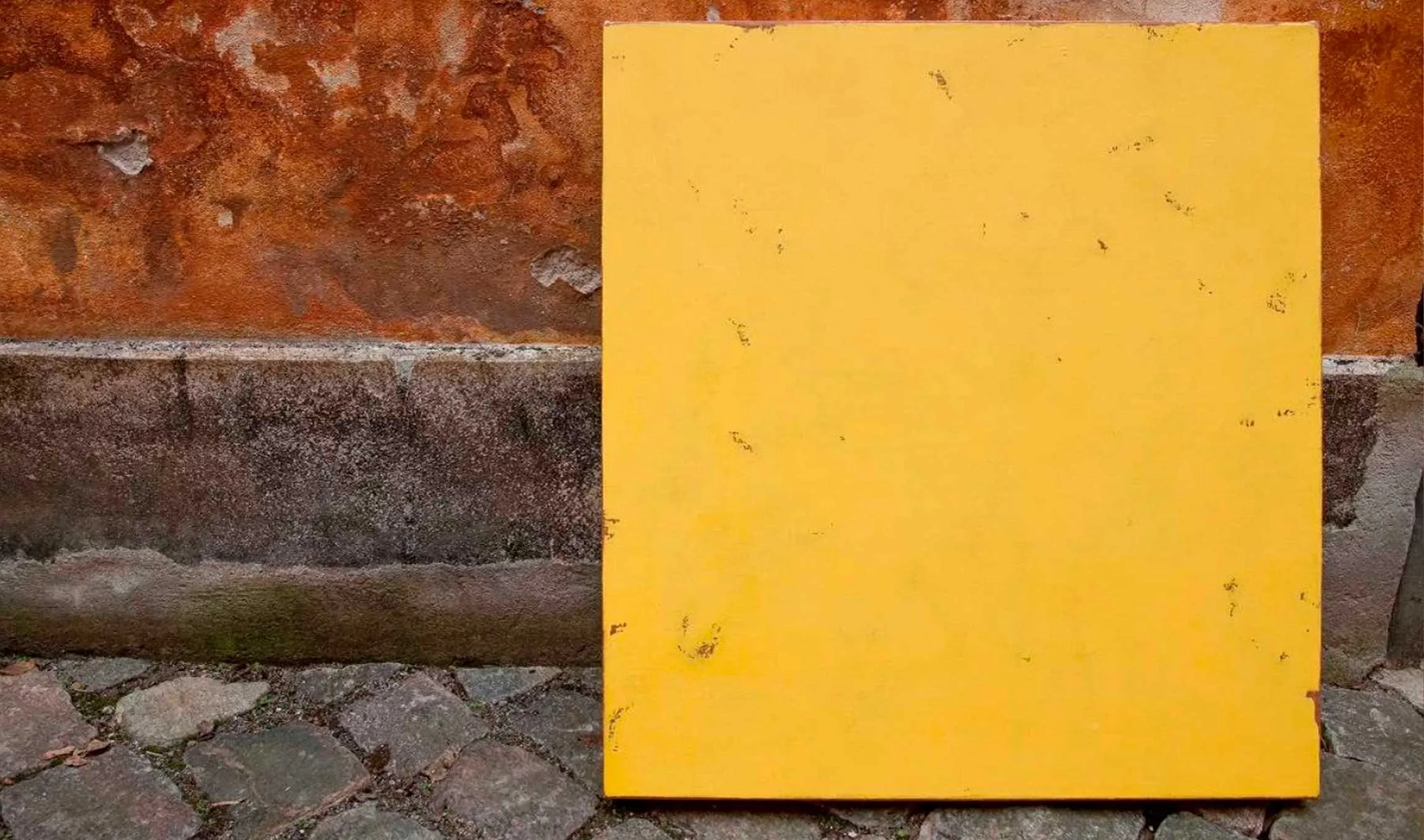
How can a yellow painting communicate anything? What is the message, the purpose, the content of a painting that consists of an almost entirely yellow surface? What is the meaning of abstract painting, really?
I understand why a nearly all-yellow painting might seem like a joke to most people, even to those who enjoy looking at art. But my mother's reaction was also reassuring, because it was genuine and entirely her own. It reflect who she is and her relationship with the world around her. Those are precisely the kinds of reactions I value when looking at a painting. There is real value in learning something new.
Studying Foreign Languages
Having a Danish mother and a Korean father, I grew up watching my parents communicate in a curious mixture of Danish and English. Apart from a few phrases, they never spoke Korean. My mother never learned much Korean, and that made me aware of just how different Danish and Korean are. Not only in the way the two languages look and sound, but also in the two cultures they express.
As a child, I remember studying foreign languages such as English, French, and German at school. Learning a new language required both time and effort. At first, many of the words sounded funny. But gradually they stopped being funny and began to make sense. The purpose of learning a second language, whatever that language may be, is essentially the same: to understand and to be understood by anyone who has learned the rules of that particular language.
As a citizen of a small country like Denmark, I have always appreciated being able to study art in a foreign language and to read books on art in English. If I had continued laughing at the funny-sounding English words instead of taking the time to learn the language, I would have limited my ability to engage with the world beyond Denmark, and, perhaps as a consequence, with the world of abstract painting as well.
How To Communicate With Heptapods
Learning something new is difficult. And if the reward is not immediately apparent, we are often tempted to give up. So what would be the point of learning how to look at an abstract painting?
In the film Arrival, the written language of the heptapods is not simply a collection of symbols with dictionary meanings. Each circular logogram is generated according to a set of rules, and as the linguist Louise Banks gradually understands those rules, her way of thinking begins to change. She does not simply learn what individual signs mean; she becomes fluent in the language as a system.
I am not suggesting that studying abstract painting will lead to dramatic Hollywood endings. But imagine understanding how an abstract painting was made and why it was made. Like learning to communicate with the heptapods through their circular ink-blot language, learning to look at abstract painting is itself something that can be learned. The reward is that something once alien can gradually become strangely familiar and even meaningful.
Scribbles, Drips, and Circles
Imagine walking into the studio in the morning to paint a masterpiece on a huge blank canvas. You are not a heptapod but an artist, and it is your task to add paint to that empty surface. Somehow you are expected to create something that changes the way people see themselves, contributes to thousands of years of art history, and perhaps even saves the world.
In 2007, when I stopped making figurative paintings, I was looking for a way of working without thinking about artistic goals. I began introducing rules and restrictions into my practice as practical tools. I did not save the world, but I did keep adding paint to canvases. In a strange way, having a structure made perfect sense to me.
The first rule was simple: use only one colour in a painting. It helped me focus on the act of painting itself and, more importantly, it kept me painting. But new questions quickly emerged. If two monochromatic paintings are hung side by side, are they one work or two? The moment I placed two paintings next to one another, I had divided the picture plane. That became the beginning of my interest in grids.
It is surprisingly difficult not to make something recognisable. Human beings are extraordinarily imaginative. We are constantly trying to find patterns and familiar forms. In 1866, the German psychiatrist Karl Ludwig Kahlbaum introduced the term Pareidolie, later translated into English as pareidolia, to describe our tendency to perceive meaningful forms where none were intentionally created.
Meaning does not emerge because what you are looking at depicts or symbolises something. Rather, abstract paintings become intelligible because they participate in a shared visual grammar. The foundation of that grammar is surprisingly simple: what you are looking at is not a recognisable figure. From there, grammar provides structure, structure provides meaning, and meaning provides a foothold for working abstractly. When I look at abstract painting, I imagine viewing it through a particular set of lenses, where monochromes, scribbles, grids, drips, circles, triangles, and squares within squares all become meaningful, not because they are masterpieces, although many of them are, but because they possess structure.
Repetitions, Variations, Exceptions, and Transformations
Grids are perhaps the simplest expression of repetition. They appear throughout the history of visual culture, from ancient Egyptian scrolls and mandalas to the pixel grids that make up the images on our computer screens. Grids are also an invaluable tool for drawing. Each line establishes the conditions for the next, and before long an endless variety of intersections and spaces begins to emerge, often without conscious planning.
When I first began working with grids, I wrote (in 2011) that I had discovered a way of making paintings that was independent of communicating a specific message, yet still deeply meaningful to me. Looking back now, I see that grids have become one of the grammatical structures that underpin my work.
A painting can be seen as a picture plane that may be divided into a grid, suggesting where any mark might be placed. At the same time, it can be understood as a single unit within a larger grid that continues beyond the edges of the painting. Looking at a painting through the lens of the grid shifts our attention towards its dimensions, its internal structure, and the way it occupies the surrounding space.
One way we learn a new language is by studying how words and sentences work together. We notice repetitions, variations, exceptions, and transformations. Gradually we begin to understand the grammar of the language. The same can be true of abstract painting. Here, too, we encounter repetition, variation, exception, and transformation. Using a method such as a grid is not only practical. Because it is part of a system, it opens up situations in which sustained looking produces observations. We might ask: Why does this variation occur here? How does the material itself contribute to the logic? What changes across a series of grids? The questions that arise from the work become part of the work itself, rather than merely a response to it. That, perhaps, is the purpose of having a system.
The idea of describing my own work in terms of grammar has emerged slowly over decades. So slowly, in fact, that it feels as though I have gradually flipped the script on meaning, images, and visual language. My aim was never to make paintings function like letters in an alphabet or to treat a painting as a visual "utterance". Grammar simply became a practical tool. It helped me hold things together and, perhaps most importantly, gave me a way to begin.
One of the cartoons I have sent to Mathias depicts a painter standing in front of a large white canvas. The painter is wonderfully dishevelled, with uncombed hair, strange slippers, and paint splattered across his clothes. Its caption reads, ”Så får I ikke mere for den 25-øre,” which roughly translates as, ”That’s all, folks”, the catchphrase on the banner shown at the end of Looney Tunes cartoons. I recognise a little of myself in this cartoon. Not because it illustrates abstract painting, but because it invites us to look beyond the painter. In this way, the cartoon perhaps unintentionally suggests that looking at abstract paintings is a strangely private affair.
Record Summary
- Type
- Essay
- Author
- Michael Baastrup Chang
- Written
- Place
- Gråbrødretorv, Copenhagen, Denmark
Archive Context
How To Look At A Yellow Painting forms part of a group of essays written in 2026 and subsequently collected under the title More On Art.
The individual essays are preserved here as separate archival records in order to retain their individual subjects, dates, references and relationships to the wider artistic practice.