How To Watch Paint Dry
Essay
“Writing is thinking. To write well is to think clearly. That’s why it’s so hard.” — David McCullough. The same can be said about painting. Painting is thinking. To paint well is to think clearly.
Learning the craft of painting allows you to avoid common problems such as cracking, sagging canvas, rot, crumbling, and delamination. But painting well can be difficult for reasons that have little to do with craft.
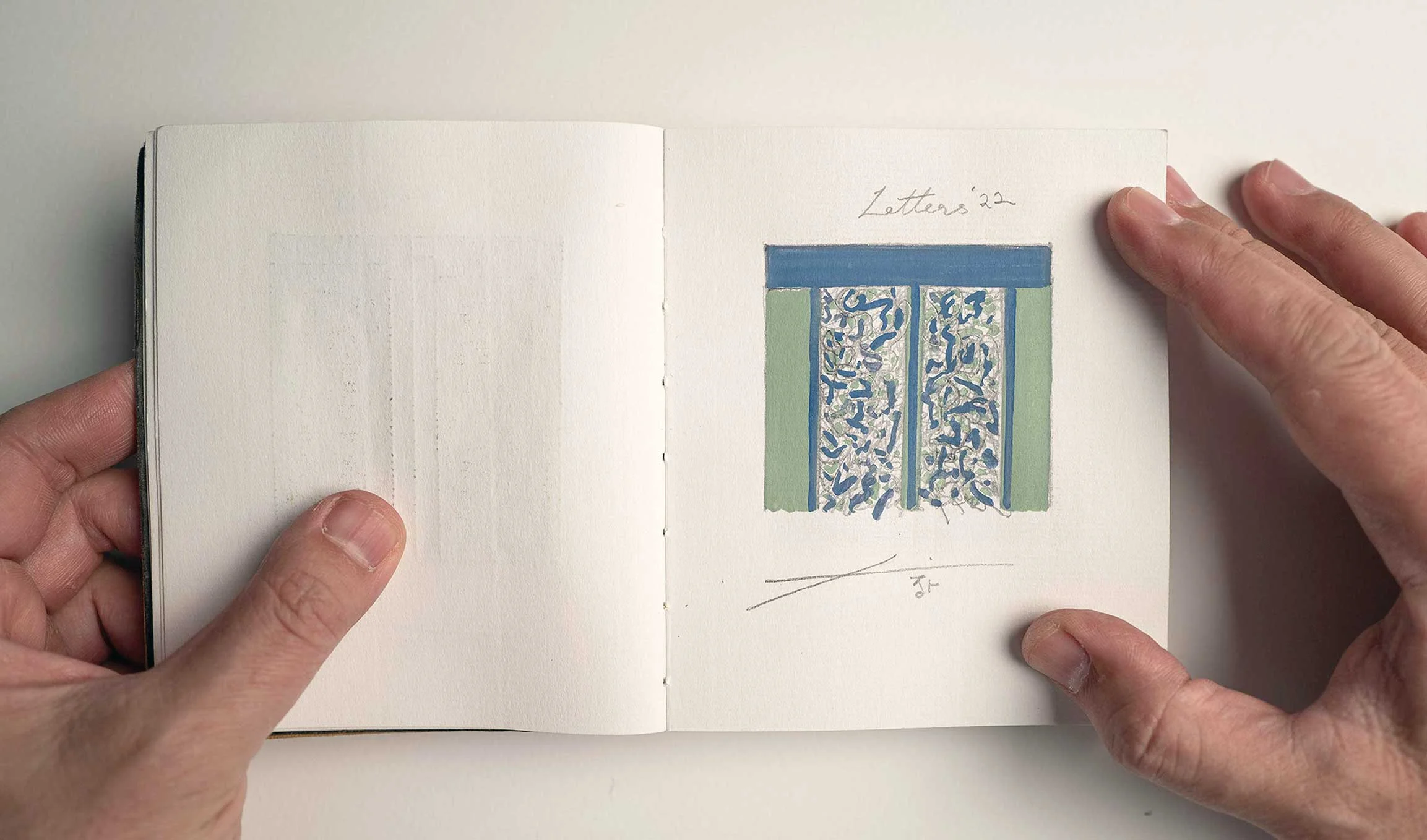
This essay explores the coherence between the concerns that occupy me as a painter and the thinking that unfolds in my sketchbooks.
Crayons and Paper
I grew up in a home filled with crayons and paper. My mother is a trained technical draughtsperson, and from an early age I was encouraged to draw.
Watching my own children write stories and make illustrations together allowed me to observe how they influenced one another as they developed a visual language.
When my oldest daughter was a teenager, she was influenced by Japanese cartoons. But as she gradually developed a style of her own, only loosely based on Manga, she was criticised by her peers.
It makes you wonder whether there are conventions in children’s drawings. A sun in the corner? Stick figures? Short arms and oversized heads? Mermaids? A lack of perspective? Sparse detail? Colouring outside the outlines?
Applied to children’s drawings, conventions of style seem strangely limiting. Would you correct a child for placing the sun in the centre of the lower half of the picture plane? Or would you find it intriguing and ask why?
As a parent, I would prefer children’s drawings to remain limitless and free from convention. When I compare my children’s early intuitive mark-making with their later learned forms of expression, style is simply not the whole picture. There are no right or wrong children’s drawings; only different stages of development and different choices being made.
Likewise, recognisable styles make artworks easier to categorise and discuss. But reducing images to questions of right and wrong is a limited way of understanding what they do.
In the documentary My Kid Could Paint That, there is a scene in which four-year-old Marla paints on a large canvas. Her father has stretched the canvas, decided its scale, and provided his daughter with paint and brushes. The scene suggests that artistic meaning emerges from choices made before the first mark appears.
The function of style is to shape perception. Instead of asking whether Marla is an artist, we should ask how she is an artist. Because she is guided by her father’s knowledge of painting and art history, that too is part of how Marla becomes an artist.
Rather than simply transmitting information, images engage our imagination. They construct a reality not only through visual means but also through intention.
The meaning of an artwork is inseparable from its material embodiment. We use our bodies to sense the world around us. A painting speaks through colour, form, and brushwork, and also through whether we perceive it as large or small, tall or wide, dry or glossy, old or newly made, sharp or rounded. Our understanding of form, shape, and material is rooted in the way we experience our own bodies.
Technical and formal questions are central to my own artistic practice. Yet formal constraints are more than decorative devices. They generate meaning beyond structure, composition, and repetition. They give rise to questions that are not immediately present on the surface.
What makes a painting modern if its style is contemporary while its rectangular format and painting techniques are ancient? And more curiously, how are form and meaning connected?
Art as a Career?
When I watch the documentary about the four-year-old artist, I cannot help adding meaning to her story.
Did she paint all the works herself? Beyond stretching the canvas, how much did her father contribute? How much of the process is collaboration? Is it a shared production? What were the motives? Who benefits from the attention? Who pays for the art? What role does the gallerist play? How much influence does Marla have over which paintings are exhibited?
It is reasonable to look for answers in the conditions under which art is produced. It is equally natural to look beyond the artist alone in order to engage with the work. Evaluation becomes a social event. Categorising artworks and passing judgement on style can be understood as ways of distributing authorship; not over the making of the artwork, but over the meanings we attach to it.
As such, the relationship between form and meaning remains open-ended. Even when artists collaborate in making a work, they have little control over what it will come to mean for its audience.
Curators, art foundations, gallerists, art historians, colleagues, museums, collectors, patrons, and the general public all contribute their own interpretations. So, what does it mean to pursue art as a career?
Models of Authorship
In Ovid’s Metamorphoses there is a cautionary tale about choosing art as a profession. The story of Arachne and Athena illustrates how authority is negotiated during a contest between a talented artist and the goddess of wisdom, warfare, and handicraft. As an artist, you are always up against dominant narratives in a struggle over authorship. External forces continually seek to define what your work means and, like Arachne, risk reducing you to a spider endlessly spinning its web.
In my own experience, artistic thought develops through a web of support and dialogue rather than through individual brilliance, let alone the myth of the solitary (usually male) genius. Rather than gods awakening our senses, animating our bodies, or transforming us into spiders, it is often family members who encourage us to draw; siblings who shape our sense of taste; correspondence with friends and colleagues that informs our understanding of a work.
All these collaborators challenge hierarchical models of authorship by participating in the making of meaning. Artistic thought is shared. It develops through dialogue, collaboration, and role models.
It is difficult to think of anything that enters the world alone. History holds its sway over the present and, no matter how hard we try, we never gain complete autonomy over our work.
Nicolas Poussin’s Blind Orion Searching for the Rising Sun (1658) suggests that we do not make our journey alone. Orion has been blinded by Oenopion, the legendary king of Chios. In Poussin’s painting there is a tiny but significant detail: the servant Cedalion stands upon Orion’s shoulders, helping the giant hunter find his way.
When we look at paintings, we do not look with our eyes alone. We look with everything we have experienced, and with everything that came before the particular painting before us.
Can visual language be separated from cultural upbringing? Are paintings autonomous objects, or are they shaped by the identity of their maker? Is it possible to look at my work and ignore my Korean and Danish heritage? How does biography provide a foundation for what we see?
There is something reassuring in the fact that we cannot escape what came before us.
Every generation wants to enter the world with an open mind and make experiences for itself. In 2011 I copied, reproduced, deconstructed, reconstructed, dissolved, wrote upon, and almost eliminated images by Paul Cézanne, Andy Warhol, Edvard Munch, Francis Bacon, and Francisco Goya. It was by no means an expression of aversion.
One of the paintings I appropriated was the painting Puberty by Edvard Munch. Rather than fleeing from the awkward uncertainty of not yet knowing, there is value in the process of becoming. Almost eliminating, dissolving, deconstructing, and reconstructing a visual language can itself become a powerful way of learning.
Reading Visual Languages
If there is coherence between my essays and my sketchbooks, it is rooted in language.
My essays and my sketches have developed simultaneously, side by side, over decades. Together they demonstrate both structure and its gradual transformation.
The function of letters is to form words that carry meaning through their relationships to one another. Likewise, a grammar for sketching is valuable because it generates an infinite number of possibilities for further exploration.
Paradoxically, in order to sketch freely I first had to establish a grammar for my visual language. It is built upon rules of limitation, constraint, repetition, grids, rectangles, systems, and sequences of numbers.
Viewed individually, the sketches in my sketchbooks resemble disjointed syllables. Seen together, they begin to reveal their underlying grammar.
Curiously, Korean is also a syllabic language, with vowels and consonants arranged into square blocks. As a child I could not read written Korean. The characters were visual riddles that I could not solve. Perhaps that intensified both my curiosity about Korea’s place in my identity and my fascination with written visual language.
The grammar I developed for my own visual language also accommodates deviations, accidents, revisions, and uncertainty. In this respect it resembles writing essays, which are short literary investigations of a subject. Grammar establishes structure. Structure makes a progressive development possible.
Individually, sketches resemble syllables waiting to be assembled into meaning. Together they form a visual syntax. Likewise, my essays repeatedly ask questions that unsettle the structures my sketches establish. Grids establish form, while the essays ask how form relates to meaning. The sketches belong to particular moments in my life, while the essays question whether biography can ever explain an artwork. The paintings emerge from systems, yet their meanings remain open to interpretation.
Do we attempt to read images in the same way that we read letters? How do visual grammars develop? What happens when the title of a work changes? Does the meaning change even when the image remains the same? Why does abstraction communicate differently from figuration? What relationships exist between all the seemingly insignificant parts?
Together, the essays and the sketchbooks become investigations into the structures through which meaning is generated. Writing is thinking. Painting is thinking. The clearer we think, the more questions emerge. Perhaps that is why it is so hard to do well.
Record Summary
- Type
- Essay
- Author
- Michael Baastrup Chang
- Written
- Place
- Gråbrødretorv, Copenhagen, Denmark
References
-
Archival record
"I Used to Think I Couldn’t Write. Now I’m Practicing Anyway."
Archive Context
How To Watch Paint Dry forms part of a group of essays written in 2026 and subsequently collected under the title More On Art.
The individual essays are preserved here as separate archival records in order to retain their individual subjects, dates, references and relationships to the wider artistic practice.