Notes On A Work Consisting Of Two Panels
Work Note
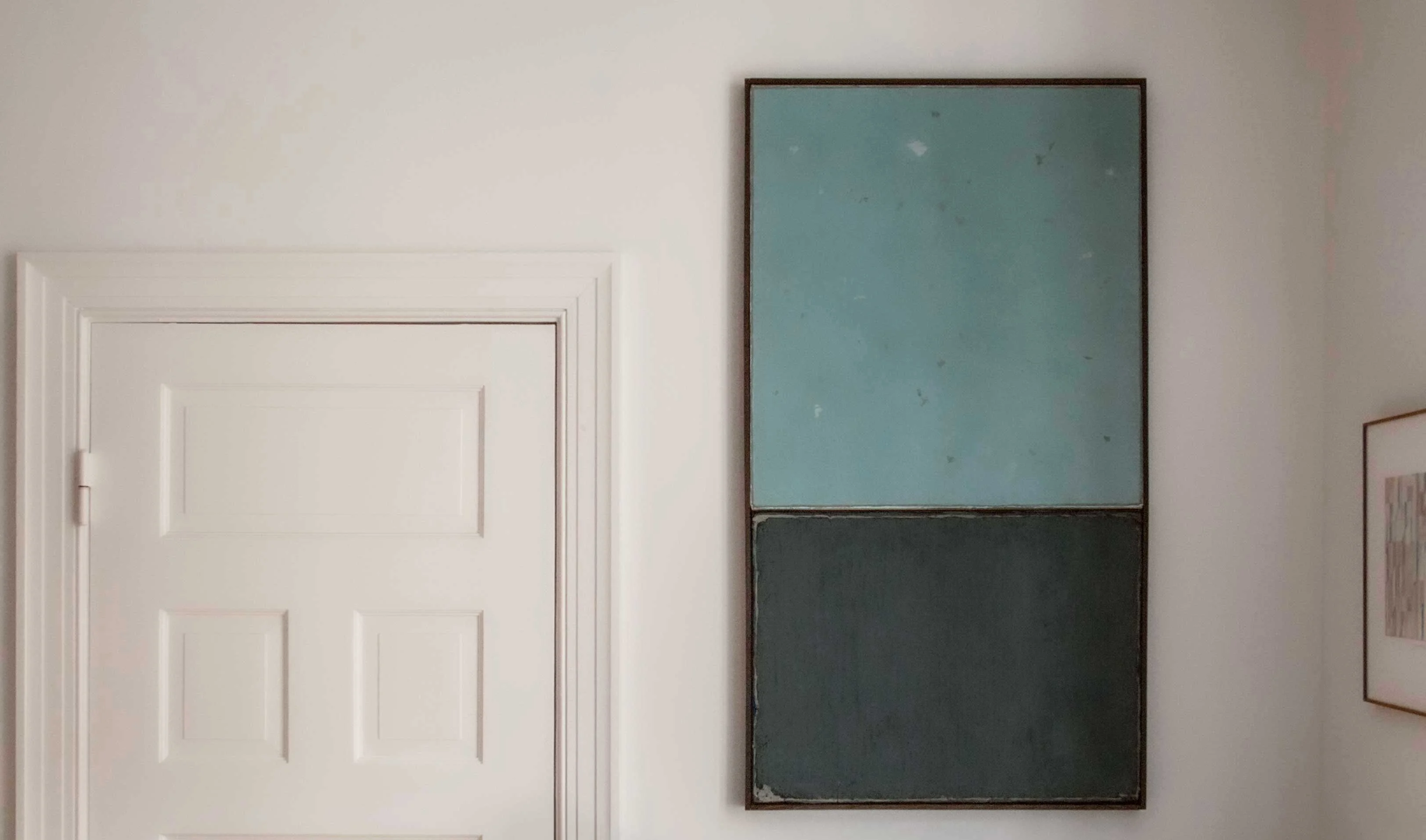
Each panel was worked on separately. Both share the same method of preparation, using layers of egg white and chalk.
The first layer of paint is egg tempera. It is applied with a brush until the entire surface is covered. The panel is then left to dry for seven weeks.
The second layer consists of handmade oil paint made from linseed oil and pigment. It is applied with a small spatula.
When I apply the second layer, I pay attention to the marks left by the spatula and nothing else. My aim is to distribute the paint as evenly as possible so that it dries evenly. I want the surface to appear homogeneous, without shiny or dry areas. This is surprisingly difficult to achieve and therefore requires constant attention.
I watch for small shapes that appear by chance as the paint is spread across the surface. The rough edges around the painted area are especially appealing to me. They remind me of the deckled edges of the handmade paper I use in printmaking. They also introduce a small element of drama into the act of painting, because the movement of the hand changes completely when it reaches the edge of the painting or a corner. A hand moving around an edge behaves differently from one moving across the middle of the painting.
Because I work in layers, tiny "islands" of the previous layer emerge through the new wet paint. A negotiation begins between covering an island and keeping it. Some islands are covered deliberately, others by accident, and some survive.
I try to avoid the appearance of anything recognisable like a sign, a face, a horse, Italy. The moment a shape becomes recognisable, I remove it. I continue working until I feel there is nothing more to add, until I can no longer find symbols in the surface, and until the painting appears to relax into itself.
Rather than expressing anything, I attempt to remove traces of intention from the surface. I don't want to find myself in the work. The painting is not invented. It is uncovered. Whether that is possible, I do not know. But it is how I want the experience of painting to feel. I want the painting to look as though it had always existed, and I simply happened to discover it. The painting is then left to dry for another seven weeks.
The third layer repeats the same procedure. It offers another opportunity to create new islands or cover those that survived the previous layer. This introduces a new challenge. I do not want the islands to acquire double edges of colour. One solution is to make an island slightly smaller so that the new paint covers its previous outline. But this inevitably changes its shape, and with every altered shape the entire surface must be reconsidered.
Each new layer added to the surface becomes a variation of the same painting rather than a step towards a predetermined image. I rarely think about where the painting will end up or what it will look like. Eventually, the work becomes what it becomes.
There is a system behind the dimensions of the paintings based on the proportions of my body and the Fibonacci sequence. When exhibited together, these proportions become part of the experience, introducing a spatial quality to the work without requiring conscious compositional decisions on the surface.
Over time, however, I have come to think of this system less as an aesthetic decision than as a practical one. It removes the need to reinvent the proportions of every new painting or drawing.
The lower panel of this particular work has a final layer made from linseed oil and beeswax. I added this layer to depart from my method.
I enjoy looking at paintings that do not feel like the execution of a preconceived design, much as I enjoy looking at a tree or a rock in nature. Or looking at walls stripped of wallpaper. What the painting means, I do not know. What does a tree or a rock mean? What does a wall stripped of wallpaper mean? I search for ways of making paintings that I can keep looking at without ever quite knowing what I will see.
Record Summary
- Type
- Work Note
- Author
- Michael Baastrup Chang
- Written
- Place
- Gråbrødretorv, Copenhagen, Denmark
Archive Context
Notes On A Work Consisting Of Two Panels was written as a work-specific account of the making of a two-panel painting. It forms part of a group of writings from 2026 subsequently collected under the title More On Art.
The individual writings are preserved here as separate archival records in order to retain their individual subjects, dates, references and relationships to the wider artistic practice.