Notes On A Work On Paper
Work Note
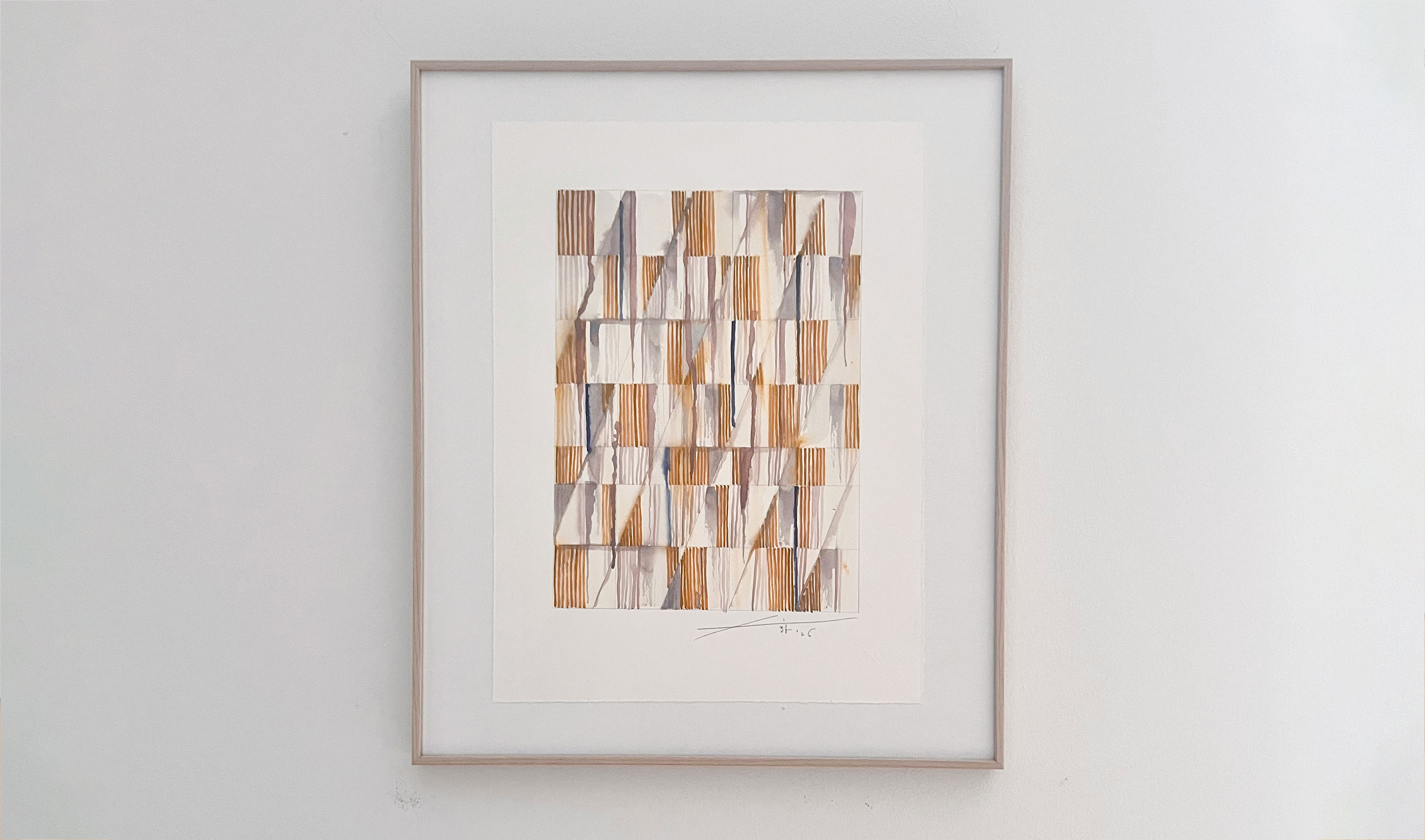
The materials used in this work are graphite, gouache and watercolour. The sketch is made in a single session. There is no preparation other than tearing a sheet from a 100 × 70 cm sheet of 300 gsm printmaking paper. The thickness of the paper is well suited to making sketches like this. The fibres are open enough to absorb watercolour, the paper is thick enough not to buckle excessively during painting.
I like my works to have a clear top and bottom. I begin by drawing a thin line, four centimetres from the edge of the paper, leaving an additional two to three centimetres at the bottom. I divide the picture plane at approximately one-third to two-thirds with a single vertical graphite line. I then draw a horizontal line using the same proportion. These two lines generate four fields within the defined space.
I continue by drawing two vertical lines, each dividing one of the four fields at approximately one-third to two-thirds. Next come three horizontal lines, each placed within three of the remaining fields according to the same principle. Then five vertical lines, eight horizontal lines, and finally thirteen vertical lines, each time selecting one of the remaining fields and dividing it using the same proportional relationship.
I add six diagonal lines spaced evenly across the picture plane. I do not carry these lines through uninterrupted. Instead, I shift them so that every second field contains part of a diagonal line. At this point I have stopped following the Fibonacci sequence directly, but the sequence continues to guide subsequent marks because of the strong geometric structure it establishes.
This concludes the first stage of the sketch.
II
I then select a colour and a brush and begin adding colour to the empty fields. I begin by adding lines in every second empty field. The lines continue to follow the one-third to two-thirds proportions established earlier. I paint an odd number of parallel lines, leaving approximately the width of one brushstroke between them.
I continue working with one colour at a time. Gradually I let go of the underlying structure and rely more on intuition and prior experience. I draw lines across the fields, follow existing lines from one field into another, vary the pressure on the brush so the paint produces irregular edges, switch to a broader brush, paint over existing lines, and redraw them.
Whenever I feel the sketch begin to drift away from me, I add marks that reinforce its underlying geometry. Conversely, if the sketch begins to appear too rigid, I abandon the structure, add more water, and allow the paint to find its own course. Sometimes I load one area heavily with paint, lift the paper, and allow gravity to pull the paint downward, temporarily surrendering part of my control over the image.
III
This sketch is one in a larger series, all made according to the same principles. Interestingly, the sketches rarely resemble one another. In fact, it is surprisingly difficult to produce two sketches that look alike using this method. At the same time, they are clearly connected through their structure, materials, colours, dimensions and method of construction.
Eventually I reach a point where I can’t add another mark. The brush hovers above the paper, searching for a place to land. This pause causes me to reconsider the entire sketch. That is when I stop. I sign the work, stamp it, and leave it to dry. It usually dries within a day.
IV
When I return to it, the sketch often appears different from the moment I stopped working on it. I rarely know where a sketch is heading while I am making it. The experience carries over into another sketch, a print or a painting. The way I approach edges, small islands of colour, relationships between colours, dimensions, and the joining of two panels all originate in experience. The experience travels freely from one medium to another, but I never try to replicate a sketch as a painting.
Everything about painting is different from sketching: the medium, the materials, the scale, the drying time, the tools I use, and the time it takes to make a painting. When I paint, I want the process to feel light and enjoyable. I focus on the experience of applying the paint itself. Everything else rests on practice.
Record Summary
- Type
- Work Note
- Author
- Michael Baastrup Chang
- Written
- Place
- Gråbrødretorv, Copenhagen, Denmark
Archive Context
Notes On A Work On Paper is a work note written in 2026 describing the construction and development of a work on paper.
The note forms part of a group of writings subsequently collected under the title More On Art. Individual writings are preserved here as separate archival records in order to retain their individual subjects, dates, processes and relationships to the wider artistic practice.