On Collaboration
Summary
- Type
- Letter
- Written
- Place
- Østerbro, Copenhagen, Denmark
- Author
- Michael Baastrup Chang
On Collaboration reflects on collaborative art practices and the different methods through which artists can work together. Drawing on seven collaborative projects, the letter considers communication, participation, technology, authorship, process and the ways in which one collaborative project can generate another.
Letter
Let me start out by saying: Collaboration is a vast and probably inexhaustible topic. Like it, love it or hate it, collaboration has firmly established itself in the art world over the past decades. As Jan Kather put it in an e-mail:
”Collaboration is a pandemic infection in the art world of the 21st Century. Enabled by digital technology and the Internet, international collaboration’s defining moment was when artists, who became infected by this collective desire to create/communicate, unintentionally caused a major shift in 21st Century art practice by stepping out of the artist-genius-working-in-isolation mode into the artist-as-collaborator-communicator- creator mode.”
What works when we work together? What happens? How do we connect? Who benefits most from collaboration? From what does collaboration benefit most? How does the way we communicate influence the outcome?
In the following, I look at some of the collaborative projects I have directly or indirectly been involved in. The observations are based on seven collaborative endeavors, each of which represents a different method of co-operating.
METHOD ONE, THE EXQUISITE CORPSE VIDEO PROJECT
It all began with The Exquisite Corpse Video Project. Exquisite Corpse, a collaborative method devised by the Surrealists in the early 1900s, is best known as a party game: after writing or drawing on a piece of paper, a player folds the paper to reveal only a small portion of her work to the next contributor, who in turn bases his own work on the visible portion and so on, until finally the paper is opened to unveil a strangely continuous, yet wildly divergent form or figure. In the spring of 2008, fourteen artists from nine countries on the social network forum at www.artreview.com were all drawn in by this comment:
”Ideas about collaborations, anyone???”
Marty McCutcheon, a painter and video artist from Berkeley, CA, suggested using the Exquisite Corpse method for a collaborative video art series. The first volume of Exquisite Corpse videos was composed over a period of two weeks. As luck would have it, two of the participating artists, Stina Pehrsdotter and Niclas Hallberg, run an independent art space, Formverk Art Zone, in their native Sweden. They screened the project at Formverk on June 4, 2008. Besides myself, participants in the first volume of Exquisite Corpse Videos were Marty McCutcheon (USA), Ambuja Magaji (India), Kika Nicolela (Brazil), Zachary Sandler (USA), Simone Stoll (Germany), John Pirard (Belgium), Niclas Hallberg (Sweden), Anders Weberg (Sweden), Alison Williams (South Africa), Stina Pehrsdotter (Sweden), Per E Riksson (Sweden), Joy Whalen (USA) and Ulf Kristiansen (Norway).
On July 12, 2008, after several months of exclusive online communication, we had our first ‘real-life’ meeting in Hornbæk, Denmark. We all found ourselves surprised by the different impressions imparted by our Internet personae as compared to our ‘analogue’ selves – as a result of the face-to-face meeting, our communication in future projects (the Fragments Multi-Channel Installation Project, for example – Method Seven) was more personal and more familiar. I am of the opinion that collaboration is not necessarily contingent on discussions or on verbal interaction at all, provided that participants have access to each other, but the combination of communication methods was of a clear advantage. It should be noted that despite the intense communication between the artists in the Exquisite Corpse Video Project, the project itself did not explicitly require participation in the forums discussion. The Vitruvian Woman Video Installation (Method Five) is an excellent example of a successful, partially non-verbal collaboration: of the 34 participating artists, only 17 posted in the project’s online forum.
After the first volume of Exquisite Corpse Videos, a closed social network was created for the group of video artists to exchange ideas, discuss the project’s process and evaluate its results. Lively discussions, for the most part conducted in languages other than the participants’ first language, characterized the discussion forum, which had 61 members by December 28, 2009. By retrospectively documenting and evaluating their efforts and results, participants were able to gain insights and experience growth of a different quality and magnitude than in an independent project.
METHOD TWO, THE EXQUISITE DIALOGUES
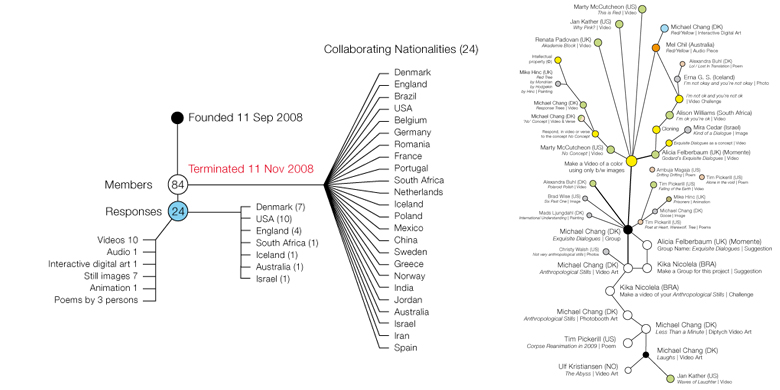
The Exquisite Dialogues Project took place online on the ArtReview website, where it ran for two months. The Exquisite Dialogues called on artists to respond to a work of art with a work of art. The nature of the artworks was unspecified and might include text, video, audio, photos, paintings etc. To stimulate responses, certain challenges were posted, for example: "Respond, in video or verse, to the concept No Concept". Replies were visualized with the help of a chart in the project’s online forum, which was updated regularly. Visually measuring the collaborative activity was a great motivation for involvement and really stimulated interaction; even when the project was no longer active, the response-visualization continued to attract members to the group. On December 20, 2009, more than one year after the conclusion of the project, the group counts 119 members. And despite the fact that the project had been finished for more than a year, a response was registered in the discussion forum on September 1st, 2009. It featured a dual-tone image of a sky with clouds and a poem.
METHOD THREE, COLORS OF CONVERSATION
The Colors of Conversation project began with a digital guestbook on my website. The idea was to interpret words with colors using a specific set of rules, and to visualize interaction. In collaboration with the Australian audio artist Melanie Chilianis, the result was outfitted with audio, generating a time-based conversation piece with colors, audio and human beings interacting on various levels.
Although the two projects overlap on the investigative timeline, they were carried out separately – an example of the essentially symbiotic nature of collaboration. The result of one collaborative project can function as input for another project and generate something entirely new and beneficial for both parties. In that sense, collaborative work can (even unintentionally) prove valuable to future collaborative projects.
METHOD FOUR, THE Y’S LETTERS
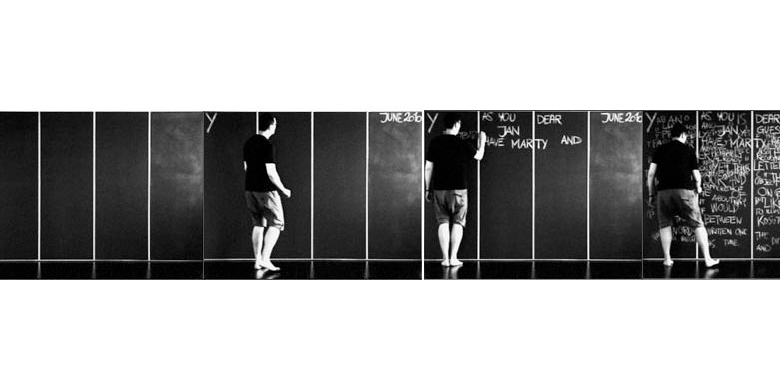
On September 23, 2008, three members of the video artists’ group began working on a sort of pen-pal document. The project, which was called “Ys” (pronounced ‘whys’), invited participants to contribute thoughts about life and art. On December 30th, 2009, the document had reached Y14 and boasted a total of 12 906 words, for an average of 922 words per response.
At some point, the Ys project found its flow. The collaborators returned to it repeatedly, and it proved to be a useful tool. I found it valuable as an anchor for lofty subject matter as well as an exercise in articulation. As simple as it is, the Ys project proves to be a well-functioning investigative tool, allowing the participants to generate content over a longer period of time as well as analyze the development of their thoughts and the way those thoughts are articulated. Unlike online discussion forums, which tend to be spontaneous and emotionally charged, the nature of the Ys document is pre-meditated and rational, a kind of a base for reflection and contemplative development and a potential starting point for other collaborative measures.
METHOD FIVE, THE VITRUVIAN WOMAN VIDEO PROJECT
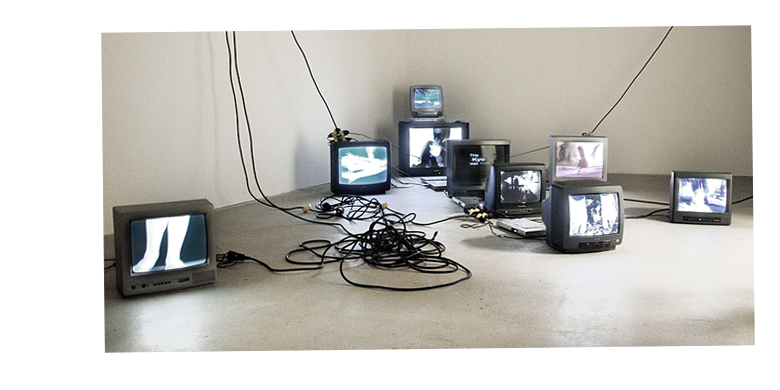
”The Vitruvian Woman Video Project is a multimedia sculpture created by 34 artists from around the world. Inspired by Leonardo da Vinci’s sketch ‘The Vitruvian Man’, which idealizes the classic proportions of the (male) human body, The Vitruvian Woman sets out to trace the multidimensionality of womanhood in a flow of five three-minute video sequences reflecting the nine bodily regions: the head, heart, stomach, genitals, right arm, left arm, left leg, right leg and feet. This poetry of dismemberment screened on nine monitors draws on diverse chapters of female identity, from scenes of domestic life to the sensibilities of lingerie and lust. Allegories of the flesh and a male beaten to pulp add to the shaky image of female empowerment as it alternately pins its hope on Buddhist mantra and surrenders to the flux of collective consciousness.”
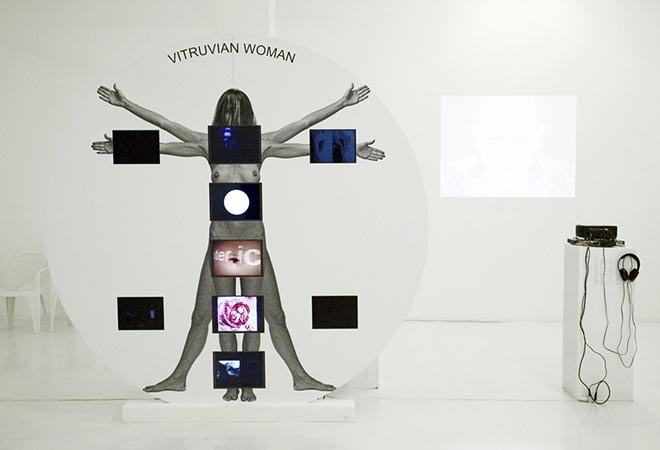
With The Vitruvian Woman Video Project, we were aiming to transpose the two-dimensional screening/projection collaboration into a three-dimensional installation. The Vitruvian Woman Project was defined and administrated in a closed online forum, tracking developments with the use of a progress chart which was updated daily. For me, the Vitruvian Woman Project was an exercise in collaboration and an experiment with collaboration’s parameters.
Beauty is in the eye of the beholder. There's no right way or wrong way to carry out a project, but there are many, many different ways. The Vitruvian Woman Project showcases and celebrates that diversity.
The participating artists came from Sweden (Niclas Hallberg and Stina Pehrsdotter) and Italy (Willy Darko, his assistant Luca Tacconi and fellow artist Irina Gabiani), and they defined the presentation of the project, which resulted in two very different visualizations. In any collaboration, there is one unchanging factor: each participant will have a very different vision for the project’s outcome. Therefore, collaboration generates something infinitely larger than any of its parts.
As in other collaborations, documenting our progress proved motivating and generated energy for the participating artists, both individually and as a group.
METHOD SIX, AUDIO VISUAL RESEARCH
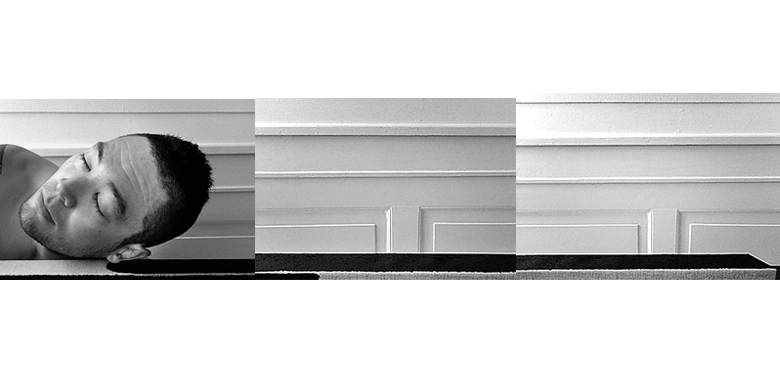
In the Exquisite Dialogue project, a Melbourne-based sonic artist responded to two challenges: "Make a video of a colour using only black and white images" and “Make a video response to the concept of ‘I'm not okay and you are not okay’". Instead of video, the sonic artist chose to submit her responses in audio form. Her variation from the challenge’s parameters did not have a negative impact on the project or the possibility for collaboration—on the contrary. An interactive html page was created in response to the audio file, which in turn inspired an entirely new interactive piece. And that piece, entitled "Red/yellow", prompted a practice-based research relationship between the Melbourne-based sonic artist and the Copenhagen-based visual artist. Diversion from a project’s prescribed parameters can be stimulating, and can push the outer limits much further than originally expected, bringing about unexpected results.
METHOD SEVEN, THE FRAGMENTS MULTI-CHANNEL INSTALLATION PROJECT
The Fragments Multi-channel Installation Project aimed to further explore Exquisite Corpse style collaboration.
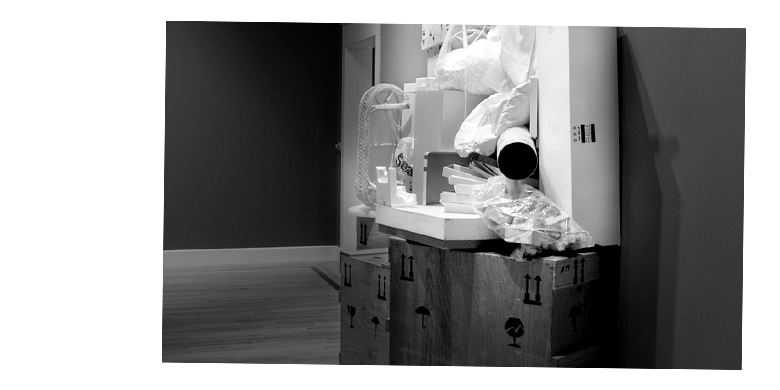
The majority of the participating artists had collaborated previously on the Exquisite Corpse Video Project (Method one). For this Internet-based project, the artists were sent the preceding artist’s complete contribution instead of receiving a ten-second excerpt, as was the case in the Exquisite Corpse Video Project. Three threads were created, each with five participants. The first artist in each thread created 1-2 minutes of video, which s/he then forwarded to the next participant, who worked with the initial vision in any way s/he saw fit. Then the new work was forwarded to the next participant and so on. The three threads were completed simultaneously, and the participants were pretty much kept in the dark about the others’ video content until the final unveiling, although a common decision about the screening was made in the online forum: the finished pieces were to be projected onto a wall covered in whitewashed fragments of broken things. Junk!
The Fragments Multi-channel Installation Project was screened at The Berkeley Commonplace Community Screening Center in Berkeley, California on July 25, 2009 and at the Arnot Art Museum in Elmira New York on April 5 to April 8, 2011. On the days of the screening, various multi-screen experiments and live performance experiments were conducted. The atmosphere created by a group of people working together on a common project is one of creativity and creative resonance, inspiration, openness and interaction. The participants in these projects, motivated by the “whole that is bigger than its parts”, choose to continue meeting ‘in real life’, working on increasingly more projects together.
Collaboration seems to function well driven by initiative and an exchange of actions towards a goal which more often than not becomes common along the way. Like independent endeavors, collaboration is time and energy consuming and not necessary easy, but participants seem to reap great advantages from the exchange on a collective as well as personal level. Often, the process and result of a collaborative project will give rise to multiple other projects, collaborative or not.
Pandemic or not, collaboration truly is contagious.
FRAGMENTS PROJECT ESSAY
There’s little doubt in our minds that collaboration across international borders is a great way to meet the challenges at the turn of the 21st century. And for that simple reason exploring collaboration in a field like art has great contemporary merit.
The Fragments Project would have been extremely difficult to realize just a decade ago, simply because there weren’t enough video artists online in art related social networks. Because of very limited Internet bandwidth in most countries at that time, no one really thought about sharing their large video files via the Internet. Services such as YouTube, Vimeo, WeTransfer and Pando came along once the bandwidth increased. The changes bandwidth brought with it, can be compared with the invention of oil paint in tubes.
The Fragments Project is what we would call groundwork. It is a study in a new field where very little research, if any, has been done by previous generations, for obvious technical reasons. The project is carried out in a modernistic sense that places emphasis on contemporary topics and especially on the method itself as a new way of working. The method is in fact a new art making vehicle. Like one of the first automobiles The Fragments Project does have an awkward pioneer quality to it and is not too concerned with aesthetics or aerodynamics. There’s motivation however and the vision is clear: there will be more movements like this one in the future. Most likely better looking, faster and more refined. And that is why being part of an event like this has a sense of significance attached to it.
For the same reasons, however, it is important to be critical about the event too. We can’t help feeling a bit like mad scientists helping to bring this strange creation to life. We wonder if this was how Nikola Tesla felt working on the induction motor and wireless communication or how Hovannes Adamian felt thinking up the tricolor principle of the color television or how Mary Shelley felt while writing about the experiments of Dr. Frankenstein?
At best The Fragments Project resonates with an image such as Picasso’s Les Demoiselles d'Avignon in the way that traditional beauty is sacrificed for the sake of a new, alienating multi-perspective. One of the points that The Fragments Project makes is that collaboration is about something else than authorship and intellectual property. Curiosity perhaps? In this sense the project is a new kind of social, multicultural investigation of art.
The practical side of collaboration in the 21st century is linked to the development of information technology and world wide access to it. Future inventions will soon make an event such as The Fragments Project look ridiculously old fashioned. Like an oversized typewriter, a fax machine, a Walkman with a 60 minutes cassette, a VHS cassette player or a floppy disc. But rather than technology, The Fragments Project places greater emphasis on human interaction.
How is it exactly, that we feel a need to communicate via sound and moving images? Why is information so important that we need to convey it to each other all the time? Why do we invent all these mediums? How is it we digest the impressions we receive from the constant flow of digital audiovisual information?
The Fragments Project questions how we consume information on a daily basis and how we respond to it. The project even questions itself as a method of presenting digital sound and moving images and questions the way in which we are surrounded by fragments of information all the time: on our watches, in our newspapers, on cell phones, on our computers, on our TVs, in our homes, on our clothes, etc. The Fragments Project projects its information onto our junk! The interactive platform provided by The Fragments Project makes it possible for the audience at Arnot Art Museum to fill up the museum space with digital audiovisual information submitted by contemporary artists and to play with these works to find out what that feels like.
Contemporary artists do have an obligation to construct works of art that make us all pause for a moment and consider the positions we put ourselves in. It might seem overwhelming to try to collaborate and to help each other without speaking the same language, without living in the same country, without sharing the same beliefs, without having similar values, without visualizing the same goals, and without having chatted and shaken hands. Interestingly, it does happen.
Traditionally speaking, in all cultures and all ages, artists have worked together towards common goals and in groups sharing certain viewpoints. In this sense what’s different about The Fragments Project is that the participating artists don’t necessary share any ideology at all. They have different cultural backgrounds and no clear visions of a common goal. They don’t speak the same languages and only very few of them have actually met each other or even exchanged e-mails. And yet their works are united for two days in the main gallery in the prominent Arnot Art Museum in Elmira, New York on April 5 – 8, 2011. In that way The Fragments Project represents something remarkably new, quite unique and quintessentially of the time we live in.
— Michael Chang and Marty McCutcheon, Copenhagen and Berkeley, March 2011
References
Kather, Jan, quote from an e-mail exchange, December 30, 2009.
Nicolela, Kika, comment posted in an online forum at www.artreview.com, 2008.
Wyon, Kim, Vitruvian Woman festival programme text, Genova, Italia, 2009.
Archive Context
On Collaboration was written as a letter arising from an ongoing exchange with collaborators about a number of collaborative projects undertaken between 2008 and 2011. It forms part of a group of letters subsequently collected under the title On Art.
The letter reflects on seven different collaborative methods and projects, drawing observations from the experience of working with artists across geographical and disciplinary boundaries, particularly through online communication and digital media.
The individual letters are preserved here as separate archival records in order to retain their individual subjects, dates, references and relationships to the wider artistic practice.