On Conveying Information About Art
Summary
- Type
- Letter
- Written
- Place
- Østerbro, Copenhagen, Denmark
- Author
- Michael Baastrup Chang
On Conveying Information About Art considers the relationship between artistic method, image, perception and the information surrounding a work of art. The letter reflects on a series of photographs made during a journey from Elmira to Ithaca and asks whether knowledge of an artwork's circumstances and method enriches or alters the experience of the work itself.
Letter
When we met in Elmira for the ’Fragments’ show earlier this year (group exhibition at the Arnot Art Museum, ed.). I needed my laptop to screen the video art, and being a notoriously light traveler, I chose to leave my trusty Leica at home. Jan, you were kind enough to lend me a camera.
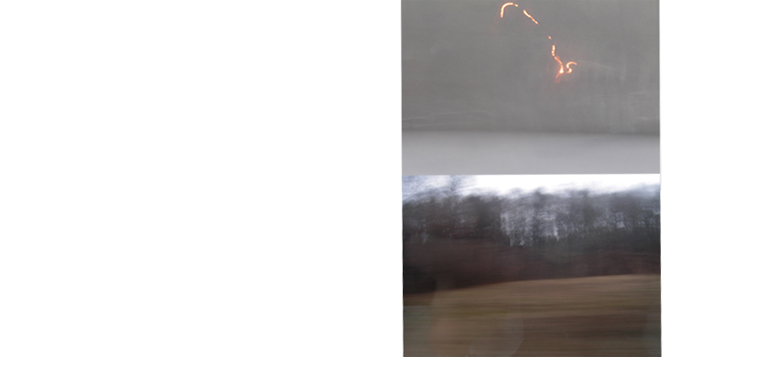
On a Monday, we drove to Cornell to do a crit-class with Jan’s photography students and I took pictures out of the car window. Because I didn’t know the camera I was using and had no idea how the pictures would turn out, I didn’t think much and just snapped shots of the landscape speeding by.
I don’t think that I was taking pictures of the view, but rather of the situation: sitting in Jan’s car on our way to the crit-class, taking pictures with her camera on the way from Elmira to Ithaca, listening to the Twin Peaks’ soundtrack and being conscious of where I was in a dream-like, David Lynch kind of way. I aimed the camera in different angles and pressed the button when it felt right.
I took ten photographs and then forgot about them. But when we downloaded them the day before I left, they really surprised me. The first image I opened spoke to me in a clear and painterly way. It was both figurative and abstract, with a clearly defined background and the sharp silhouettes of trees on top of the hillside set against a grey and misty sky. The perspective gave the image in an interesting layered structure, with the trees growing larger and larger, then disappearing into a valley with the hill before they reached the road. I remember telling Jan that I thought this image would change the way I work.
After I saw the photographs I had taken, I got to thinking about the relationship between image and method. The series I took with Jan’s camera imparts a special mood, and that mood may well be the only content the images offer a viewer.
But how can we possibly know what our images will mean to another person? We can analyze their formal aspects – colors, dynamics, contrast. We can compare them to other images and make associations, but it is nothing more than speculation and projection and it fails to address the images’ potential meanings.
Information about methods in art is indispensible for scholars of art and valuable for spectators. But do the conditions under which an image has come to be influence how a spectator perceives that image? Knowing them certainly helps in a formal analysis. At the same time however, it taints the sensory experience that is arguably the true content of the work.
In Elmira, we spoke a lot about methods in visual arts. In the spirit of the inspiration and warmth that I still carry with me from these conversations, I ask you the following:
Is the experience of art, situated in the work of art themselves, or inside the person looking at the work of art?
If we believe the latter, further information about the works is obviously very relevant. If we believe the former, only the work itself is relevant. I find this paradox intriguing and therefore pass this question on to you.
References
The Fragments Project, group exhibition, Arnot Art Museum, Elmira, New York, 5–8 April 2011.
Cornell University, Ithaca, New York, photography critique session, 2011.
Lynch, David, Twin Peaks, television series, 1990–1991.
Archive Context
On Conveying Information About Art was originally written as an email letter to friends. It forms part of a group of letters written around 2010–2011 and subsequently collected under the title On Art.
The individual letters are preserved here as separate archival records in order to retain their individual subjects, dates, references and relationships to the wider artistic practice.