On Fantasy, Play, Language And Poetic Function
Summary
- Type
- Letter
- Written
- Place
- Gothersgade, Copenhagen, Denmark
- Author
- Michael Baastrup Chang
On Fantasy, Play, Language And Poetic Function considers the relationship between childhood play, drawing, imagination, language and art. The letter reflects on the ability to imagine one thing while seeing another, the role of poetic function in the creation and reception of art, and the importance of preserving play and creative freedom in adult life.
Letter
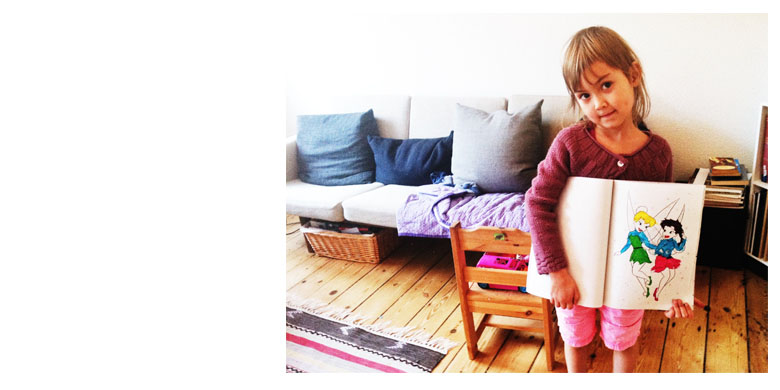
Recently I had the opportunity to sit and observe Kastanje while she drew in a room adjacent to where I was. I could hear her, fantasy racing, creating a dialogue between the two characters she was coloring. She told a story using several voices:
Oh, blue! said the winter fairy. Oh blue! said Tinkerbell. And they both have blue eyes! Oh yes!, I'd like to have blue eyes, too! Me too Tinkerbell! Look, what color is my dress? Green! Yes, green! And what color dress do I usually wear? Green! Yes, that's right! See you on the next page!
She soon began singing, but the melody wasn't anything I had heard before, and the words weren't real words, only sounds. I believe that I witnessed a poem, a song and a drawing coming into being simultaneously.
Watching the uninhibited release of Kastanje's potential through story, song and drawing was an interesting experience. Her play lasted for hours. Even as four year-olds, I realized, we are in possession of vivid imaginations and creative power. I'm very grateful to have such a beautiful source of inspiration so close at hand.
My work with art has taught me that we use art in many different ways; as an unbridling of personal potential, like Kastanje, for one. But we also use it as an identity or as socialization, as an ideal and an idea, as a status symbol and an investment; as an experience, as entertainment, provocation, communication, critique and decoration; as the culmination of knowledge or a way to relay knowledge, and still more.
Interestingly, we can also use art to reflect on our existence. We might reflect on our existence because we want to figure out where we stand and where we're going, and the reality check can reveal new ways to tackle old problems and get new results. In short, for personal growth.
When I visited Marty in Berkeley for the first time in 2009, I recorded one of our conversations, which I later used as the soundtrack for a video. In the recording, my voice says that I believe that art has contributed to our development as a civilization over the past 30,000 years, and that art has made us able to truly connect with one another in a variety of ways, using images, song and storytelling, among other things.
I believe that the ability to see one thing and imagine another is and has been pivotal for our development. The ability to imagine allows us to communicate via symbols, and without it, we would be unable to use images and physical objects as a departure point for reflection.
For practical reasons, in my day-to-day work I have distanced myself from the idea that art can be a physical object. I can produce any number of paintings, drawings or plates, but find that I often speculate about when, where and why my painting, drawing or graphic becomes art.
In her thesis in visual culture at the University of Copenhagen, Kirstine Autzen writes about what she calls Poetic Function — poetic from the Greek poesis, which means to create. Poetic function is what occurs inside of us when we see two superimposed images: we begin, pretty much automatically, to create something out of the two images. Something temporary? Something meaningful? A content-based coincidence, or a dualism? Colors or forms that complement or repel one another? Photography is central for Kirstine's review of poetic function, but other images, sounds or symbols like numbers or letters can easily give poetic function its starting impulse.
For the creator of a work, the question what is it can at times have devastating consequences for spontaneous poetic function. At other times it may also be an inspiration.
There are differences in how accustomed we are at using art. Using art requires learning to take authority over a work, as well as exploring how others receive it. We construct poetic function individually and what we see is, of course, also individual even if we're looking at the same thing.
For me, painting, drawing and graphic work can be an accumulation of knowledge, materials and actions that extend over a period of time, and the art is the registration of my time in a certain form. But the object itself is rarely my point of departure; more often, the point of departure is myself and my relationship to the world.
That using art requires practice is a fact that is not common knowledge. In the documentary My Kid Could Paint That (2007), which is about a painting child and media darling from Binghamton, New York, the writer and art critic Michael Kimmelman remarks that we often accept that many things require practice — sports, or playing the piano — but somehow the sense that art is effortless survives. I like the notion that we might need to train ourselves to see a work of art, just as we need to learn to react to a hard-pitched baseball.
When I see Kastanje orchestrating her play with language while she draws, there is poetic function between her world and mine. Her play resonates with my own play with drawing, language and music, and my own amalgam of fiction and reality.
I think we need to protect the impulse and ability to play, both alone and together. And I believe that we can increase our overall potential by giving ourselves space for play. Maybe play is more important for our development than we think?
As adults, we gradually get used to various limitations. But it doesn't always make sense to adapt to the systems around us — certainly not without reflecting thoroughly on how and why those systems are in place. Art is not self-explanatory, and images are not always clear for everyone, and that in turn allows for mysterious parallel worlds to arise, sometimes with their very own languages. The jocular guide to International Art English (IAE), to which I recently sent you a link, has been a catalyst of sorts for this letter, by the way: A User's Guide to Artspeak .
As a response to the IAE article, Jan Kather sent me a link to an Artist Statement Generator, 500letters.org, which also serves as a warning that the rhetorical system may be convincing, but also banal and devoid of content. Language is a tool with which we can limit our view or set our imaginations free.
As much as I love to see the world through the objective lens that language is, I also love to remove that objective and experience the world without.
We've written a lot about these topics already, but I encourage you to share any thoughts you might have with me and each other.
Fondly,
Michael
Archive Context
On Fantasy, Play, Language And Poetic Function was written as part of a group of letters concerning art, artistic practice, perception, language and the development of ideas around the work.
The individual letters are preserved here as separate archival records in order to retain their individual subjects, dates, references and relationships to the wider artistic practice.