On Grids
Summary
- Type
- Letter
- Written
- Place
- Østerbro, Copenhagen, Denmark
- Author
- Michael Baastrup Chang
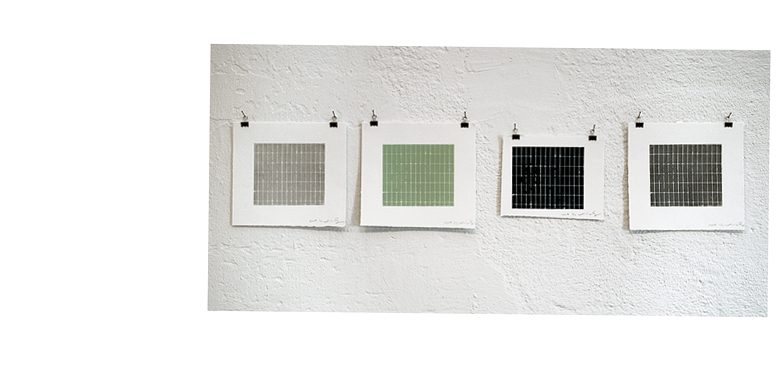
On Grids considers the grid as both an artistic tool and a subject in its own right. The letter examines grids in relation to drawing, painting, perspective, gesture, space, composition and the development of artistic practice.
Letter
When I first began working with grids, I found that I had discovered a modality that was independent of imparting a specific message, and yet still allowed me to produce work that was very meaningful to me. What grids lack in societal critique and emotionally charged subject matter, they compensate for with their structure and their subconscious interplay, which makes them an interesting subject for reflection.
Grids are all around us. The grid plan (Hippodamian plan) has been implemented in urban planning for millennia, from ancient Greece and Pakistan to New York and Portland, Oregon. They are also relevant for the written language. Take ancient Egyptian scrolls and sarcophagus engravings, for instance, or the organization of written languages on a page. In my children’s art, I have witnessed the strength that a grid structure provides for the creation of beautiful mandalas (‘mandala’ comes from the Sanskrit word for ‘disk’), a sacred symbol which represents the universe in Buddhism and Hinduism. Grid systems support the digital age, representing high- or low-resolution images on a computer screen.
Grids can also be used to analyze gestures in space. Take for example the movements of a body. A grid gently lifted up from the picture plane and transformed to a three-dimensional mesh that surrounds the body can provide lines to record the body’s gestures. Grids are thus linked to brushstrokes and their direction in space, to abstract expressionism and even performance art and dance: While I was working with Christy Walsh on “Stories of the Sun God”, I learned that grids are used as an invisible structure for ballet and modern dance to provide anchor points for a dancer’s movements.
Grids are of course a valuable tool for sketching. Each line generates the foundation for the next line and before you know it, there are endless variations of intersecting lines and spaces, often produced without even thinking. Getting accustomed to working with grids (not to mention to working without thinking) can release the picture plane, as well as new ways of working with it. Drawing with a grid might even be likened to a study of the nature of a plane and its possibilities, its challenges and likely constructions. This type of work directs attention to the nature of edges as well as the nature of a plane’s proportions – and even what the physical presence of the painting as an object in a space can be about.
One of the central considerations of a painter is how the layers of a painting are constructed and how the plane reads visually, physically, sensually and conceptually. Since ancient times grids have been used to lay the foundation for compositions, and grids inspire mathematical compositions allied with sequencing and scale.
The fine arts are concerned with the definition, occupation, division and control of space. Grids are both two- and three-dimensional and can define cubes as well as planes, playing with the concept of where a work of art begins and ends. For example, a grid space can be created using as little as a string as a boundary and the result declared a sculpture of air. This conceptual work of art presents the viewer with a conundrum: is the string part of the work or not? Is it inside or outside the sculpture of air? Is the string itself the work of art, or merely a delineation?
So grids are not only powerful tools for the production of art but potent expressions in their own right. When I visited the ABEX exhibition at the MoMA in October, 2010, I encountered a painting by Robert Motherwell from 1941 entitled “The Little Spanish Prison”. “The Little Spanish Prison” was a divergence from the other Motherwell paintings on exhibit, as well as a departure from Motherwell’s signature black vertical and oval shapes against a white backdrop: it features instead six white and six yellow vertical stripes, several of which are linked together on the top left hand side by a short, horizontal red rectangle.
Both stripes and grids use lines, but their claim on space is different. In the visual arts, both stripes and grids serve as tools to mathematically define space and generate images. In a way, grids divide space, while stripes occupy space with their frequency. In “The Little Spanish Prison”, Motherwell achieved both effects by intersecting his twelve vertical stripes with a horizontal red rectangle on the top left hand side.
I remember suggesting to Jan [Kather], with whom I visited the exhibition, that the painting was more about Motherwell’s personal development as a painter than anything else; that it was a steppingstone as well as an arrival. I later read an exchange between Motherwell and Paul Cummings about that very painting that supported my suspicion. Cummings remarked that “The Little Spanish Prison” seemed to have been a key picture, and Motherwell replied that the painting had “hit something that is deep in [his] character […] But what it is I don't know. What it stands for I don't know.”
“The Little Spanish Prison” seemed to have been a key picture.
— Cummings, Paul, Interviews Robert Motherwell, Archives of American Art, Smithsonian Institution, November 24, 1971
“The Little Spanish Prison” did indeed refer to actual events, as I later learned, but the painting is as much about formal means in visual art as it is Motherwell’s experiences with the law enforcement of Franco’s fascist regime, his emotions and his personal growth as an artist. Despite its apparent simplicity, the grid painting can be about anything we bring to it – and if we want, even more.
Grids are also inexorably linked to Albrecht Dürer, whose perspective device made out of wire strung in a frame was essentially a portable grid that aided him in capturing a plausible perspective of any type of scenery.
Contemporary artists still use grids to capture perspective, and they don’t stop there. Post-modernist Dürers investigate the perspective device itself as subject matter, directing attention to the structure/grid while the scenery beyond it remains coolly encapsulated in mesh.
Grids are of almost infinite potential and much more can be said about them. They are like skeletons, inviting us to rearrange their bones and hang flesh on them as we wish. The opportunities inherent in the grid are infinite, as the grid itself.
Archive Context
On Grids was originally written as an email letter to friends. It forms part of a group of letters written around 2011 and subsequently collected under the title On Art.
The individual letters are preserved here as separate archival records in order to retain their individual subjects, dates, references and relationships to the wider artistic practice.