On Looking At Art
Summary
- Type
- Letter
- Written
- Place
- Charlottenlund, Copenhagen, Denmark
- Author
- Michael Baastrup Chang
On Looking At Art considers how art is viewed and judged, using a personal experience of professional criticism to examine the relationship between artistic practice, perception, context and judgment. The letter also explores the relationship between how and why we are artists.
Letter
First off I’d like to thank you for your generous feedback on my e-mails about the critique of my nude drawings in the series ”Images of Eggs”. I’m truly grateful to have had the opportunity to pick up some threads related to an essential element in what we do: how we view art.
The word how seems a natural extension of the word why. The title of all of these essays, Y, is derived from the question why. Specifically, why are we artists? But in the texts I see that they bring forth the answer to the more tangible question of how we are artists. Why seems almost concealed between the lines of how. How is the carrier that bears forth why. The why I seek is not causal but functional!
I can’t offer any better explanation for why I am an artist other than that art is quite simply what I want to spend the majority of my time and life on. I find the questions and problems that arise during work both stimulating and highly motivating. The professional and the existential problems often dance cheek to cheek, and the motivation for this particular letter is that dance between the professional craftsmanship of a nude drawing and the existential conditions under which an artist is weighed and measured by his contemporaries.
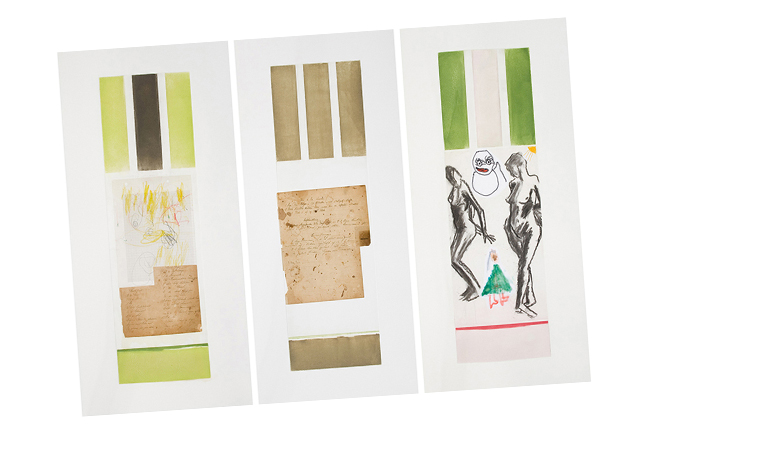
As I mentioned in my e-mail, I recently received some criticism from a colleague on the quality of two of the nude drawings in a collage in the series ”Images of Eggs” (2011). My colleague, who had earlier encouraged me to apply for admission into the Danish Fine Arts Academy’s Kunstnersamfundet (a jury-selected society of fine artists and architects involved in the Danish Academy’s work and which acts as a national advisory board in artistic issues –ed.), declared that an artist of my age (I was born in 1973) should be able to produce better quality drawings. I therefore view the critique as an expression of professional concern and a warning that the quality of these two nudes would hinder my being accepted into the Kunstnersamfund. In other words, my colleague retracted her backing of my application.
Being a sensitive man, I was very affected by the criticism. It made no difference that the nudes were close to twenty years old. I don’t know if I could draw as well today as I did in 1994; nowadays I’m more interested in the qualities of materials and surfaces.
Your responses to my e-mails helped me on my return to my emotional center. I have chosen to follow my intuition and not apply to any kunstnersamfund, seeing as I don’t feel the need to fill my days with anything more pressing than my own projects; on the contrary, I’ve decided to spend less of my time on activities that don’t directly support the three-year work agenda hanging on the wall of my studio. More on that at a later date.
The interesting thing about this distressing ordeal is the question of how we view art. It also gives me the opportunity to include a reference to an essay project: a research review entitled Nordic Visual Arts Education in Transition, which I came across online.
I quote:
"Among the many studies reviewed by Funch (op. cit.), Michael Parsons’ (1987a-b) phenomenological work on how we understand art is the most well-known one in the Nordic countries. Parsons classified people’s responses to paintings in four categories based upon what they primarily were looking for in a work of art: subject matter (including ideas of beauty and realism); emotional expression; medium, form and style; and the nature of judgment."
I find Parson’s four categories interesting in the context of this particular essay: Subject Matter. Emotional expression. Medium, form and style. And the nature of judgment.
When I look at the collage in which the two nudes are featured, it is without the twisting of any body’s arms that I can say that the subject matter is the human form; in particular the female body.
The emotional expression is warm and humorous with a mild self-ironic element in that two nude drawings are coupled with two children’s drawings depicting essentially the same subject matter. These different interpretations of the female form are interesting, as it is that the collage portrays a classic female form despite the differences.
In the uppermost figure there is focus on the face, particularly the eyelashes and red lips. That a woman is reduced to eyelashes and a pair of bright red lips is thought-provoking in and of itself. The woman in the lower figure has been outfitted with hair, a triangular dress and a lovely pair of red boots. The two nudes are posed in a hard light, symbolized by a little sun in the uppermost right corner – also evocative of a classical children’s placement of a shining sun.
Medium, form and style are a copperplate print: aquatint with a chine collé collage.
The nature of judgment. I’ve always hoped that my visual works would be assessed in their context, not dissected like frogs and read like coffee grounds. At the same time I don’t want to make a big thing out of explaining my work. Ergo I must clarify for myself how and with what objective I am an artist (that is, why).
Both questions are relevant, and that feeling of relevance is something I have chosen to spend my time documenting in this letter; this way, I can always come back to the words on paper and true the compass I use to navigate in my life and work. The path of work we have chosen is a special one. As I’ve said earlier, my friendship to you helps me preserve my courage.
Archive Context
On Looking At Art was originally written as an e-mail letter to friends. It forms part of a group of letters written around 2011 and 2012 and subsequently collected under the title On Art.
The individual letters are preserved here as separate archival records in order to retain their individual subjects, dates, references and relationships to the wider artistic practice.