On Perception
Summary
- Type
- Letter
- Written
- Place
- Østerbro, Copenhagen, Denmark
- Author
- Michael Baastrup Chang
On Perception considers the relationship between perception, the body, painting and knowledge. The letter examines the role of the eye in organizing visual information, the physical presence of painting, the language used to describe painting, and the possibility of rejecting established categories through which painting is understood.
Letter
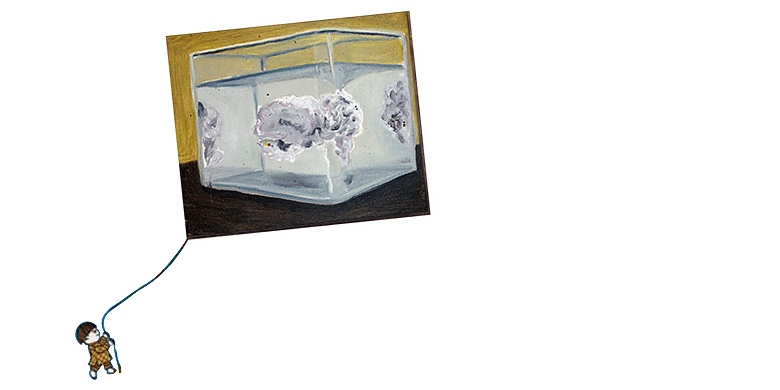
In the late 1950s, while Warren Sturgis McCulloch was doing research at MIT, he discovered, on a frog, the eye’s valuable role in organizing and interpreting visual information before it is sent to the brain. Let’s consider perception for a moment.
Given that the eyes play an integral role in preparing information for the brain, the location of the eyes on the human body is logical. Eyes behind the knees, say, would be a less advantageous arrangement. The human brain is moist, spongy, and safely shelved out of harm’s way inside a ventless skull. It’s an eager organ which takes up precious few percent of the human anatomy and continually prompts us to identify the nature of reality by examining its symptoms. Our external features (our fairly symmetrical hands, feet, arms, legs, nostrils…) are far superior to the internal at sensing worldly qualities; we use our external, physical bodies to gather information and determine if something is tall, wide, hard, soft, dry, moist, rough, smooth, flaky, hairy, mat, shiny, cold, warm, sweet, sour, bitter, salty, putrid, fragrant, far away, close, outside, inside, natural or unnatural, etc. We define the world according to how our external bodies experience it.
Painting creates both a physical presence for our bodies to sense and experience and information for our eyes to organize, interpret, and convey to our brains. The act of painting is the labor of executing the objects we call paintings. Part of being a painter may be trying to come up with new ways to perceive the act of painting—either in an uncertain, groundbreaking way or by drawing out traditions to lead to renewal. The contents of our minds can be handed over easily, like a baton. Paintings have a physicality that deteriorates and in this way they speak to the senses of the body. What painting is about is linked to what physical presence is about.
As we know from exploratory surgery performed on green animals with webbed digits and protruding eyes, perception and knowledge are intrinsically linked. Therefore, the responsibility of eyeballing a painting in a modern museum today can be placed on, or in, the eyeball itself. But if we look at art with our brains, viewing a painting as a work of art becomes an act of introspection. For instance, in the Sistine Chapel there is a fresco of a naked young man lying on the ground, one arm raised limply. The arm points towards an elderly male, who in turn points back while hovering in front of a deep red organic shape reminiscent of the sagittal plane of the human brain. One possible interpretation of the composition is that the elderly patriarch is a product of the human brain. The exercise in the Apostolic Chapel then suggests that ideas activate our sensory system and animate our bodies. Painting is paradoxical, because looking at paintings sparks ideas, which after all, aren’t there on the surface.
Linguistically, painting in the beginning of the 21st century is defined by the idea of pluralism. Terms like Hard-edge painting, Geometric abstraction, Appropriation, Hyperrealism, Photorealism, Expressionism, Minimalism, Lyrical Abstraction, Pop art, Op art, Abstract Expressionism, Color Field painting, Monochrome painting, Neo-expressionism, Collage, Intermedia painting, Assemblage painting, Digital painting, Postmodern painting, Neo-Dada painting, Shaped canvas painting, Environmental Mural painting, Graffiti, traditional Figure painting, Landscape painting and Portrait painting, these are all ways of ‘perceiving’ painting.
Now, if we apply the concept ‘pluralism’ to the history of painting a hundred years ago, the list is shorter. Projecting the idea of pluralism a hundred years in the future, we can reasonably assume that the list will be longer; that is, new ways of perceiving painting will be added to its ”history”. But because history is deeply rooted in language, changing the course of the history of painting requires nothing more than the rejection of any verbal description of the act of painting.
”No to spectacle, no to virtuosity, no to transformations and magic and make-believe, no to glamour and transcendence of the star image, no to the heroic, no to the anti-heroic, no to trash imagery, no to the involvement of performer or spectator, no to style, no to camp, no to seduction of spectator by the wiles of the performer, no to eccentricity, no to moving or being moved.”
I’d like to add to Yvonne Rainer’s No Manifesto from the 1960s:
No to Hard-edge painting, no to Geometric abstraction, no to Appropriation, no to Hyperrealism, no to photorealism, no to Expressionism, no to Minimalism, no to Lyrical Abstraction, no to Pop art, no to Op art, no to Abstract Expressionism, no to Color Field painting, no to Monochrome painting, no to Neo-expressionism, no to Collage, no to Intermedia painting, no to Assemblage painting, no to Digital painting, no to Postmodern painting, no to Neo-Dada painting, no to Shaped canvas painting, no to Environmental mural painting, no to Graffiti, no to traditional figure painting, no to Landscape painting and no to Portrait painting. No to mimesis, no to abstraction, no to realism, no to naturalism, no to romanticism, no to idealism, no to elitism, and no to populism. No to gesture, no to skill, no to concepts, no to content, no to communication, no to language, no to messages, no to articulation of ideas and emotions. No to critique, appraisal and commentary. No to elements of art, no to color, no to line, no to space and composition, no to rhythm, no to texture, no to shape, no to form. No to aesthetics and appreciation of beauty. No to theory and practice. No to art. No to artists.
References
Viola, Bill, “Peter Campus—Image and Self,” Art in America, 5 February 2010. Preserved excerpt · Wayback Machine archive
Arnheim, Rudolf, Art and Visual Perception: A Psychology of the Creative Eye, University of California Press, 2004.
Levin, Patricia Lynne, About Turns: Minimalism to Excess in the Films of Yvonne Rainer, University of California, Irvine, 2001.
Rainer, Yvonne, “No Manifesto”, 1965.
Archive Context
On Perception was originally written as an email letter to friends. It forms part of a group of letters written around 2010 and subsequently collected under the title On Art.
The individual letters are preserved here as separate archival records in order to retain their individual subjects, dates, references and relationships to the wider artistic practice.