On Pots, Pitchers And Other Containers
Summary
- Type
- Letter
- Written
- Place
- Charlottenlund, Denmark
- Author
- Michael Baastrup Chang
On Pots, Pitchers And Other Containers considers the relationship between containers and their contents, and extends this idea to painting, information, materials, form and perception. The letter reflects on vessels as both physical and metaphorical structures and considers how the form of a work can influence the experience of what it contains.
Letter
Lately I’ve been thinking about containers.
The impact that a vessel can have on its content – even on the same content – is fascinating. Drinking water from a plastic bottle is an entirely different experience than drinking water from a ceramic bowl. A drink of water direct from the tap, from a glass or standing open-mouthed in the rain in your garden are three other ways of experiencing the same substance. Even if we don’t necessarily give them much thought, a container’s shape and material influence us.
The same thought is interesting with respect to paintings. Can a painting also be experienced as a vessel with a content? What is the impact of a painting’s material and form on our experience of its content? Can a painting be considered as a reflection of the content we ourselves bear, thus rendering us containers of sorts?
Thoughts like these have let me see containers in a new way. When looking at the vases, jars and drinking cups in the historical wing of a museum recently, I was able to appreciate them. It is natural for a container’s form and materials to relate to the container’s content, as well as to our experience of its content as we use it.
Containers are not limited to material content; we can liken information to the content of a bowl or a cup. Some years ago I took part in a seminar on meditation that lasted several days. The lecturer took extended pauses often, in part to carefully choose her words and in part to allow her listeners to take in her words. At the end of the first day she told us that our cups were full; we should go home and “empty our cups” for the next day’s seminar.
In order to make use of the information we gather, it is necessary to organize it systematically. We write world histories and annals and summaries and surveys in the attempt to manage the sheer mass of information which we (can) constantly amass. Books, internet and other media are a storage space in fair disarray. As far as containers go, the internet is quite like the universe itself: a container with no outer limits and brimming with innumerable smaller containers. It’s no wonder that search engines, portals, news media and reference works have become such an indispensable part of the modern human’s everyday.
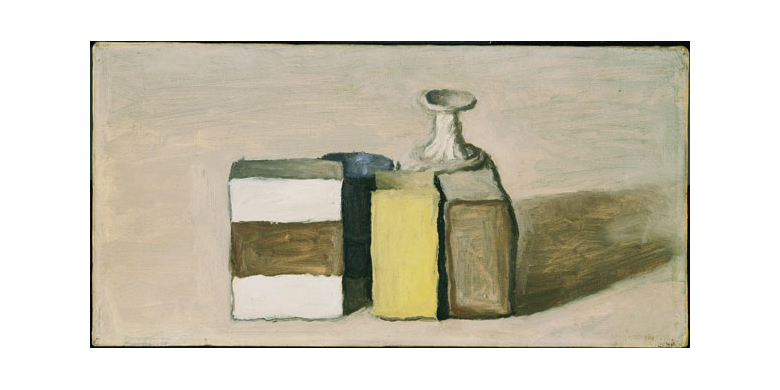
Portrayals of containers are often simultaneously concrete and figurative. When I look at Morandi’s paintings of vases and vessels, I can’t help but see the objects as metaphors for a simple existence, all standing gathered into a group. The renderings are simple. They are painted with tenderness, but also with conviction: the color nuances are delicate, introverted and almost translucent, like the skin of a very old person, but each individual brushstroke is perfectly measured with respect to its subject.
The complexity lies in Morandi’s treatment of the painting. The subject matter could have been (and become) a portrayal in a multitude of ways. The vases are painted in a style verging on abstraction – like Turner’s work, they belong to a borderland. Perhaps unwittingly, Morandi’s still-lifes glide over in an interpretation of reality we now refer to as modern. Personally, I see Morandi’s containers as a philosophical investigation of existence, somber images that are both a distant relation to and the utter opposite of vanitas.
In a book of Korean art I came across a vase whose singular form had been used as the benchmark for an entire craft. In that the vase bore an idea as well as represented a craft, it was a container in both a literal and a figurative sense. I was quite taken by its form and the fact that it was entirely white: the color was of particular relevance in the judgement of a vase’s quality. The simple form of a little white vase and the small variations in craftsmanship were the decisive elements. As no two vases could ever be perfectly identical, this can also be considered a rather existential investigation.
Inspired by the white vase, I wanted to recreate it as an image. My feeling was that the space surrounding the vase was more important than the form of the vase itself. But after several attempts I realized that I could stop trying to define the vase’s form. Instead, I could approach it as the potter does, treating the painting and its construction as clay. At the end of that little mental journey, I found myself in a place strikingly similar to my original point of departure for my work with monochromes – albeit with a different way of seeing the work, and that is a key distinction for me.
In other words, I filled the container and then emptied it to make room for something else.
There’s so much more to discover in containers, their content and their potential meanings. I’m sure you’ve thought about them too – maybe you’d like to put your thoughts to words and share them?
"On a very large-yet-personal scale, a container for me, for many years, was the flute – its practices and expectations that come with classical schooling in an instrument shaping my listening and thinking. [...]
[...] As a container, what did [the flute] outline? The western canon, a clear-as-a-bell sound which I struggled to get [...] and so I rebelled and aimed for an ugly sound! In hindsight, the electric guitar would have been a better container for my adolescent emotions and body, but for some reason, I couldn't let go! Why do we become attached to some containers, even when they enslave us?
What did the flute give as a positive? The tools and techniques of music, what it felt like to play through continuously, while performing as an embodied container, a musician with the breath. This musician-sense of play-through, phrasing, rhythm stays with everything I do today [...]. I had the instinct first but I have to admit it was the container, the flute, that helped hone it. And playing with others in their various container-ships that brought growth.
Other musical or sonic based containers? There would be many cross-cultural forms to think about. One that comes to mind is the Japanese aesthetic concept of ma[...]. This is the space between events or a moment that is intangible. In Shakuhachi music, the breath spaces between phrases becomes quite important, much more so than in western classical music, where the wind player is trained to quickly gulp down the breath and move on. In Shakuhachi music, the phrase ends and lingers, the player pauses. It is calm. A new phrase starts at a moment in the silence like a drop in a pond. Perhaps the ma concept is a kind of 'porcelain vase' container here, the white shape to be perceived by each player (still allowing variations in materials/sound backdrop etc.).
An Australian Aboriginal example. The spirituality – or Dreamings – of the Aboriginals reaches back 40,000 years, however it is constantly adapting to the changing environment and circumstance. One post-invasion example is the invention of the Toyota-dreaming – where 4-wheel drives were introduced significantly altering ways of life and landscape. This capacity to evolve new Dreamings to explain difficult and altered ways of life is another kind of container, a shared spiritual container.
— Melanie Chilianis, quote from a reply to "On Pots, Pitchers and Other Containers", October 9, 2012
Archive Context
On Pots, Pitchers And Other Containers forms part of the group of letters written by Michael Baastrup Chang around 2011–2012 and subsequently collected under the title On Art.
The letter extends the discussion of artistic materials and perception into the relationship between containers and their contents. A response from Melanie Chilianis is preserved with the record because it continues the letter’s central idea through music, Japanese aesthetics and Aboriginal spirituality.