On Rectangles
Summary
- Type
- Letter
- Written
- Place
- Charlottenlund, Denmark
- Author
- Michael Baastrup Chang
On Rectangles was originally written to accompany a work purchased by a collector. The letter considers the rectangle as a form in visual art and reflects on abstraction, concrete art, modern art, artistic practice, perception, ownership and the experience of living with a work of art.
Letter
Just a Rectangle?
Dear C. and N.,
A rectangle is a four-sided figure whose parallel sides measure equal length and whose angles all measure 90°. It’s a figure we take for granted, especially in art. But if we imagine the first time man saw a rectangle drawn on a surface, we can conjure up the simple figure’s strong and defined lines in our mind’s eye.
A four-sided shape with parallel sides of equal length and four right angles is formidably well-suited for bearing visual art, as we can see in the work of Kasimir Malevich, Alexander Rodchenko, Agnes Martin, Brice Marden, Sol Lewitt, Donald Judd, Barnett Newman, Carl Andre and others. The work you have purchased is an extension and an expansion of these artists’ work.
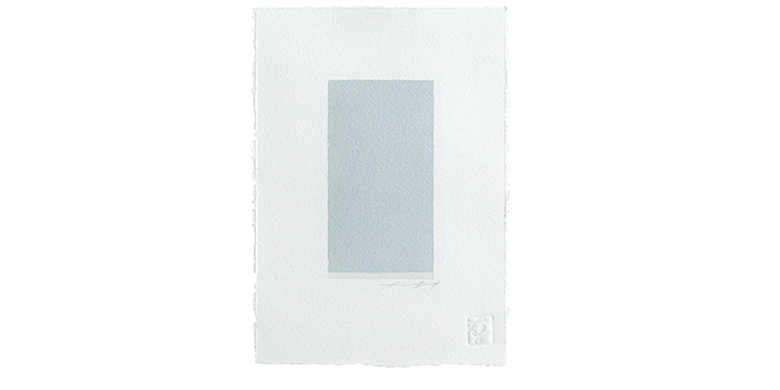
In the little work, a subdued blue and off-white do indeed form a rectangle. Most would call the work abstract, but abstract is perhaps misleading in this case, for the rectangle is a representation of a rectangle. And surely a rectangle cannot be accused of being an abstraction?
Another term for works of this sort is concrete (meaning: it is what it is), but that doesn’t quite define the work either. There is more to the work than mere formalism.
One might also say that the work is a piece of modern art, a label which, at best, serves to categorize works of art which are difficult to categorize.
When we think modern art, we often think of MoMA in New York or SF MoMA in San Francisco or the many other MoMAs around the globe. But is a modest aquarelle like this one modern? The word rectangle and the technique aquarelle date back thousands of years. What makes a work modern? And what does the word modern mean? And if a work is art, in what way is it art?
In addition to technical concerns and challenges, the exploration of questions like these is an integral part of my work as a visual artist. As far as I’m concerned, it is part of the job description.
The questions themselves dictate the results of my work. I make demands of myself in my work, as do most people who work. One of these is that each and every work that I produce should reach beyond my own bank of knowledge and understanding. Ambitious? Perhaps. But essentially, it means that each work has an immanent function and that function is a catalyst for a chain of questions about the label art and our nature.
That dogma means a protracted work process and it can make the results of my work a bit difficult to look at. It also makes each work unique. The work of which you are now owner exists only once. Although my work is based on repetitive techniques, each work is like the step of a ladder or the branch of a tree; it is unique and does not need to be repeated.
Experiencing the works entails taking the time to intuitively observe and speculate on existence. If the work is visible on an everyday basis, existential thoughts will often simply gradually sneak in and begin their transformation. Maybe not always for the better, but certainly always for the more mature. As a visual artist I am acutely aware of this responsibility and I create each of my works with the utmost sincerity.
Simple works like the one you have purchased are often misunderstood. Part of the misunderstanding arises because at first glance, simple works don’t appear to carry any content. Are they a sham? Now that you’ve bought a little blue rectangle you might find yourselves confronted with a similar perspective. I encounter it sometimes and find it to be interesting thought material.
It seems improbable that so many artists who are so deeply engrossed in their work (myself included) should dedicate so much of their lives to working with art just to swindle and damage others. Working with the delicate and nearly invisible elements of our existence necessarily entails receiving biting criticism and being overlooked – not exactly the traditional definition of success or acclaim. In reality though, it may be easier to extol a figurative artist than an abstract one. Most visual artists (even abstract artists) are exceptionally talented at figurative rendering. But if drawing comes easily to an artist, s/he will often be attracted to something else, wanting maybe more than to just be talented. That’s been my experience, at least.
You have chosen to buy an artwork and support my work. I consider the transaction a donation to my work as a visual artist and praise for my work which I do not take for granted. I thank you.
I find it important to emphasize that when a simple work of art is created with sincerity, there is an additional element to that work which can be experienced. One must be open to the paradoxical idea that something so simple has a function, which you have clearly already done. That art doesn’t have a function is a common misconception, propagated even by Metro-Goldwyn-Mayer Studios’ logo ars gratia artis, “art for the sake of art”. Many a Hollywood film has been roared in by that cranky lion. But art is a term much younger than cave paintings or the linguistic developments made parallel to them. So if we dispense with art and determine that a linguistic label exists for its own sake, we can remain in the realm of words and ask ourselves questions such as, for example, when a book is art – when it is open and being read? Or when it’s closed?
By way of the specific dogmas I work with, the content of my works is inherently accessible for the viewer. I’ve left the door open and there is nothing in the way, such as for example an ample nude body, a fragile vase or a dithering portrait, a sweeping landscape or a romantic bouquet of flowers which one might call beautiful, when what one really means is complete; that is, there is no cucumber tucked into the stems. But in the work you’ve bought there is neither fruit nor vegetable nor anything else but an open gate into the work. Not literally, of course. If the blue form were a door, it would be closed. If the motive were a different one, the path would lead us someplace else; maybe someplace we already knew well. We tend to be most comfortable with what we already know and the patterns that our heads (and hearts) recognize. If this is the first work of its type which you own, you are on the threshold of a new world.
As a word of warning, I have to add that that world – or universe, as it were – has pulled me deeper and deeper inside and there is probably no way out. Like Alice in Wonderland, I’ve found myself engulfed by a fantastic place, for better or worse. Maybe the work is an invitation to that place?
People might call you naïve. I don’t think you are, but we’re all a little naïve sometimes, in our own ways. But naïveté is a luxury; sometimes I’d like to wish myself back to my own childhood and bring back some of the innocence I see in my children. It’s a luxury, like boredom is a luxury, or owning a work of art made of water in the shape of a rectangle. A work made of water makes me think: water can be drank or drown, evaporate or rain down, wear through stone and wear down steel, bring us indoor heating and warm baths, scorch or freeze us. Or give us aquarelles, among other things.
Technically speaking, the work is an aquarelle. It was created in 2011 and instead of describing my work process in detail, I encourage you to buy a watercolor book from Arches 300 g/m2 Rough 100% cotton, a paintbrush and the two colors I used: Davy’s Grey and Prussian Blue from Winsor & Newton. Do it for fun, for your wonderful children or yourselves or, if you should encounter skepticism and criticism of the type “I could have painted that”, you’ll have a grand old time letting your critic give it a try. For it is not as easy as it looks. The material is water, which runs when you try to form it into a rectangle, and at the point where the brush must be lifted from the paper, pigment and water will pool like a bubble of water and produce a groovy flower-power design fit for a 1970’s t-shirt.
You could try with a stencil of some sort, but water is very stubborn and it will be absorbed by the paper below in spite of almost every kind of stencil. With beautiful results – but not, however, a harmonious rectangle.
Another method might be to print the colored area onto the paper. It has been tested without success and it was not the case for this piece. I can reveal, however, that the brush I used is a 4–5 cm flat nylon brush; the kind usually used for lacquer.
But only with years of practice, technical cunning and the utmost care can one paint a simple rectangle in aquarelles. And now that I’ve done it, I don’t have to do it again. Imagine.
See you behind the looking glass.
With heartfelt regards,
M. C.
Archive Context
On Rectangles was originally written as a personal letter to collectors to accompany a work purchased in 2012. Unlike the general letters in the On Art series, this text was written in direct relation to a specific work and its new owners.
The letter is preserved here as a separate archival record in order to retain its original personal address, discussion of the work, artistic context and closing correspondence.