On The Korean Alphabet, Grammar and Grey Areas
Summary
- Type
- Letter
- Written
- Place
- Gothersgade, Copenhagen, Denmark
- Author
- Michael Baastrup Chang
On The Korean Alphabet, Grammar and Grey Areas presents an artist statement and reflects on the relationship between objects, images and language. The letter considers transcultural identity, Korean language and culture, monochrome painting, a personal grammar for images, and the use of rules and limitations as a method for artistic investigation.
Letter
I finally managed to write an artist statement and here it is.
Through my work with visual art, I explore the relationships between objects, images and language. I am motivated by the notion that objects, images and languages hold court in a gray area; perhaps even more so because I feel that as the child of a South Korean and a Dane my own identity also inhabits a transcultural gray area.
My awareness of the differences between written Danish and Korean came early, but there are even certain similarities.
Unlike written Chinese with its thousands of unique and composite characters, the Korean alphabet is a syllabic language with 24 letters, ten vowels and fourteen consonants. The Korean letters, however, are not arranged from left to right; the vowels and consonants are instead arranged in quadrants, and each quadrant can contain two to five letters.
As a child I did not understand written Korean. The letters were riddles that I couldn’t solve, which perhaps intensified a sense of urgency to explore Korea’s role as part of my identity. I grew up in Denmark, and Danish culture is what I know best. But those with transcultural backgrounds often find themselves searching for meaning in their cultures of origin.
Though Korean culture is an ancient mystery to me, it is a mystery in which I form a part. As such, it serves as a boundless treasure trove of inspiration.
Exploring Korean cultural history feels like an expedition into unknown territories. I study Korea’s history and the phonetics and writing system of the Korean language. I interpret and document what I’ve discovered in paintings, graphic prints and drawings.
The resulting work is neither Danish nor Korean, neither stork nor carp, but both like myself.
Approaching the journey as a visual artist allows me to deepen my understanding of Korea while expressing myself with more cultural diversity than if I had sat down with a book and begun to study Korean.
MONOCHROMES ANEW
Attempting to unite Western and Eastern thought in my work is relevant and natural because of my own position between two cultures. With the exploration of Western and Eastern art history and the images I create, I learn more about who I am.
After years of figurative painting, I one day decided to approach my work from a different angle. I parted from figuratism, choosing instead to concentrate on the relationship between objects, images and language.
Needing a methodology for my studies, in 2007 I decided to work with monochrome paintings. Monochromes link the work that I do with abstract art in the Western world’s art history, and at the same time there are ties to Zen Buddhist monochrome art in Korea.
Despite that, I don’t see my work as an extension of a genre, mysticism or the longing for a bygone era and its isms. The monochrome is a dualistic paradox whose transcultural nature is fitting for my own project.
It is my wish to use a distinct visual language to express myself, which is why I make use of a personal grammar for my images.
A GRAMMAR FOR IMAGES
When I explore semiotics in my work, I try to dissolve the dividing lines between physical objects, images and the spoken or written language. By doing so I hope to highlight the problematic nature of their relationships with one another.
I use limitations as a tool, determining a set of dogmas and implementing them as a grammar for images. As in the Danish Dogme 95 films, a vernacular then develops between the objects I create.
The first three dogmas in my grammar for images are the most pertinent to that patois: (1) Auto-biography, (2) Proportions, (3) Gesticulation.
These three elements are a part of every work I produce, until I modify the grammar.
RESULTS OF MY STUDIES
My technique produces a variety of results. Sometimes a monochrome will reduce an image to a simple object. But because the object is constructed from a grammar, the image will always function as part of a language. When the objects are joined, a linguistic process can begin.
Blind Orion searching for the setting sun, (Orion and Cedalion) after Poussin, 2011
Works like The Blind Orion (2011) are designed as four objects on a wall with a treated finish. When light hits the treated wall, it creates the image of four colored surfaces.
Monochromes are not only extroverted and didactic, but also introverted and open to endless interpretation. Because of that, monochrome images can be used to gradually call memories and emotions to mind, echoing long after interaction.
The viewer is part of that experience, and I strive to create works that are worth returning to.
Y, 2010
The aforementioned grammar was also behind a letter composed to two of my colleagues. It was written in chalk across four vertical boards until the words disappeared into countless chalk strokes, and the letter transformed into a horizontal image. With the help of accumulated gestures, the metamorphosis from letter to image could occur.
Thus the letter’s content becomes encrypted, as a sentence written in a foreign alphabet.
IMAGES OF EGGS, 2012
Adhering to the same grammar, I have produced works based on the collection of family documents from five generations, creating collages of graphic statements comparable to the Korean alphabet’s vowels and consonants. Each collage contains words such as life, family, reproduction or relative.
CURRENT PROJECTS, 2013/2014
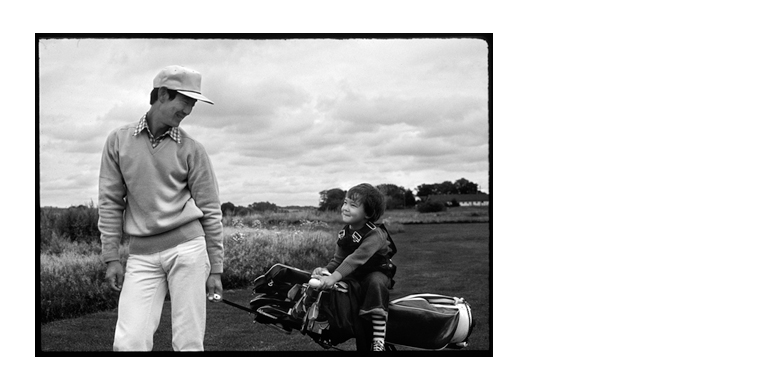
I am currently exploring fatherhood as a subject. I intend to use my grammar for images to investigate fatherhood in an exhibition of copper print, photogravure and monochrome works. In June I’ll be traveling to San Francisco, USA to attend a course in photogravures at Crown Point Press. Send me an email if you’d like to be notified with opening dates for the exhibition.
Archive Context
On The Korean Alphabet, Grammar and Grey Areas was originally written as an artist statement and letter in 2013. It forms part of a group of letters and writings subsequently collected under the title On Art.
The individual letters are preserved here as separate archival records in order to retain their individual subjects, dates, references and relationships to the wider artistic practice.