On Children’s Drawings
Summary
- Type
- Letter
- Written
- Place
- Østerbro, Copenhagen, Denmark
- Author
- Michael Baastrup Chang
On Children’s Drawings considers the relationship between childhood drawing and artistic development. The letter reflects on the drawings of Michael Baastrup Chang’s four daughters, the emergence of figurative representation, the development of individual artistic methods, the role of criticism, and the relationship between childhood experience and the development of an artist.
Correspondence
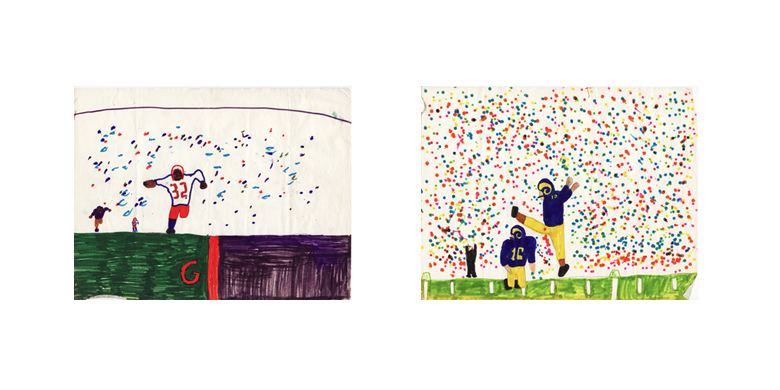
“My memory of childhood drawing is mostly focussed around age 9 or 10, I think. I drew football scenes. It might be interesting to note that I never went to actual football games, so my drawings were based on television and the newspaper. A few years ago, my uncle, my mother's brother, found these between the pages of an old book: O.J. Simpson and Tom Dempsey”
Letter
As you know, I am the proud father of four daughters. With the many joys and challenges of being a parent come renewed views of the world we inhabit (not to mention of oneself!). As an artist I’ve been particularly tuned in to my children’s drawings. Among other things I find there to be interesting parallels between art history and the artistic development of a child, and I’d like to share some of my observations with you.
From pictures and e-mails you’ll know that I have consciously allowed my youngest daughter Kastanje to draw and paint on any surface in our home without limitations. My objective has been to encourage and facilitate her visual development as fully as possible. I praise her work, making it a point to ask about her experience in drawing.
By permitting Kastanje to express herself anywhere in our home, I’ve had the opportunity to notice some of the parallels between art history and a child’s first artistic experiences. For example, Kastanje’s first ”paintings” were decidedly investigative. They were without figurative ideals and expressionistic; her sole motivation seems to be some sort of internal impulse. I believe that impulse lies latent in all of us, and that we can choose whether or not we wish to react to it.
With three older sisters who love to draw, the figurative universe was bound to find its way into Kastanje’s world. One of the first examples of just that was on the first blank page of a bedtime story: it is a picture of me, and as Kastanje explained, she hadn’t been able to finish drawing one of my eyes. It’s clear from the drawing that she knew where on a face the eyes should be placed and that there should be two of them for the representation to make sense. Figures soon became an important part of Kastanje’s reality and her drawings changed from the application of color to strokes and contours. I framed that first drawing and hung it on my wall.
As I was writing this today, Kastanje drew another picture of me. This time, the elements of my face are outside of my head, which in turn is placed on a long body, which she has filled in. She doesn’t seem troubled by the fact that the two eyes and the smiling curve of a mouth are placed outside of the head; she just seems satisfied that everything is there.
I wonder if the same applies to other things as well. Do we mirror our own physiognomy in the world and feel most at ease when the world responds with a body with a head, a nose, a mouth, two eyes …? I wrote earlier about the effect that the body’s symmetry has on our perception and the way we interpret the world. I can now confirm that the effect is already active and can be be expressed in a drawing from about three years of age.
Kastanje’s closest older sister is Josefine. Josefine clearly considers her material when drawing, which is why I introduced her to watercolors, gouache, oil pastels, graphite pencils and charcoal at a rather early age. Her readiness to take on those challenges shows me how natural it is for humans to use the materials available to us in the world.
Early on Josefine began filling out sheets of paper with color. Kastanje did the same, but unlike her younger sister Josefine didn’t use an array of colors, preferring instead to choose only one. Her drawings from that period are as finished as my own, and they even share the same content: materials and the frequency of visible light.
At six years old, Josefine has a crystal clear vision for her drawings. ”Mistakes” in her drawings can bring her to the edge of tears. Josefine is already creating ideals which can be difficult for her hands to realize: she has already begun a classic struggle with criticism which quite clearly begins in our intellect.
I’m guessing that the internal battle between ideals and reality is what gives us the chance to develop our potential. In the challenging process we get to know ourselves, learning from our experiences and maturing with them.
And art is about persistence. Maybe talent lies in the recognition of that internal battle.
I consider it my responsibility to show Josefine that I make ”mistakes” in my work, but that ”mistakes” can also be an opportunity to discover something unexpected and arrive somewhere further than merely ”right”.
Josefine’s willowy older sister Filippa is more of a dreamer of nature than her sister. In a lot of ways she is Josefine’s opposite – this is reflected in her drawings, with their fine strokes and feather-light tones.
Filippa spent a lot of her time drawing patterns early on. She would divide her drawing paper into segments, filling each one with different colors and designs made up of different graphic elements and varying strokes. Her drawings reveal a knack for combining small features to create a larger whole, and her compositions are often fascinating – for example her self-portrait, in which her face is divided with a wire mesh pattern.
Frederikke is the oldest of the sister-flock. Like her sisters, she began drawing at a tender young age. Unlike her sisters, Frederikke has always been most fascinated by the contours of drawing, and at 15 years of age (in 2011), she has created a unique universe and a ”stroke” that combines precision with great implicitness.
Frederikke spends a lot of time exploring different comic styles, and for a while she was inspired by the Japanese comic style manga. She studied it in depth, even writing an essay about manga’s role as part of Japan’s antique cultural heritage.
But a couple of years ago, she suddenly turned away from manga and began to develop her own style, which was a combination of both Eastern and Western elements. She shared her drawings online with a community of other young budding artists and received quite a bit of criticism. They couldn’t get their minds around it, declaring simply that it was neither fish nor fowl.
Luckily Frederikke shared her thoughts and feelings about their criticism with me. Teenagers need a lot of resisting power to stand up against their surroundings and preserve their autonomy. Frederikke was naturally vulnerable when it came to her peer’s criticism, but it was obviously important that she continue exploring the authentic and not allow criticism to dictate her direction or stifle her curiosity.
It is essential to be prepared for criticism to come from a variety of sources and to learn to use criticism as a constructive tool.
In November 2011, I was a resident artist at Statens Værksteder for Kunst (Danish Art Workshops), where I worked with copperplate prints for my upcoming exhibition Billeder af æg (Images of Eggs). I took Frederikke with me to give her a behind-the-scenes look at the process, and she made a series of engravings based on brilliant and unique drawings from her private visual universe.
The series of copperplate prints I’ve been working on for the upcoming show brings together my great- grandmother and my grandmother’s hand-penned recipes with my mother’s childhood drawings, my own childhood drawings and my children’s childhood drawings. I’ll tell you more about the show soon in another letter. In the meantime, I’m interested in hearing your thoughts about childhood drawings – your parents’, your children’s, your own?
References
Statens Værksteder for Kunst (Danish Art Workshops), Copenhagen, artist residency, November 2011.
Billeder af æg (Images of Eggs), forthcoming exhibition referenced in the letter, 2011.
Persian miniature painting.
Japanese woodblock prints.
Archive Context
On Children’s Drawings was originally written as an email letter to friends. It forms part of a group of letters written around 2010–2011 and subsequently collected under the title On Art.
The surviving correspondence includes replies from Marty McCutcheon and Jan Kather, which are preserved with the letter as part of the archival record.
The individual letters are preserved here as separate archival records in order to retain their individual subjects, dates, references and relationships to the wider artistic practice.