Regarding The Journeyman
Catalogue Text
Melissa E. Feldman. MA in Art History, Independent curator and writer. Published: 2011. Piedmont, California.
Recently Michael Chang wrote about affinities in the work of an unlikely triad of artists—Damien Hirst, Bob Dylan, and Her Majesty Queen Margrethe II—proposing artmaking as a great equalizer between people, be they rich, poor, famous or obscure. He notes that “the chances of us becoming colleagues outside the realm of painting are slim.” Last year Dylan, who explains that “If I could have expressed the same in a song, I would have written a song instead”, “came out” as a painter with a show at the National Gallery of Denmark. While Hirst’s blockbuster art epitomizes the late twentieth-century artist, Her Majesty Queen Margrethe II exercises her passion for and considerable gifts in both ecclesiastical embroidery and landscape painting, her royal position notwithstanding. In the case of Dylan and Her Majesty, artistic identity does not function in its usual elitist manner; on the contrary, it has a normalizing, even humanizing, effect on how we view these untouchables.
The works comprising The Journeyman might be understood as extending the purview of Chang’s dialogue with artistic “colleagues” to include Francis Bacon, Paul Cezanne, Francisco Goya, Edvard Munch, Andy Warhol, as well as a few American minimalist painters encountered through the artist’s armchair and airplane travels. But before we get to them, let’s talk about his other colleagues: all of you.
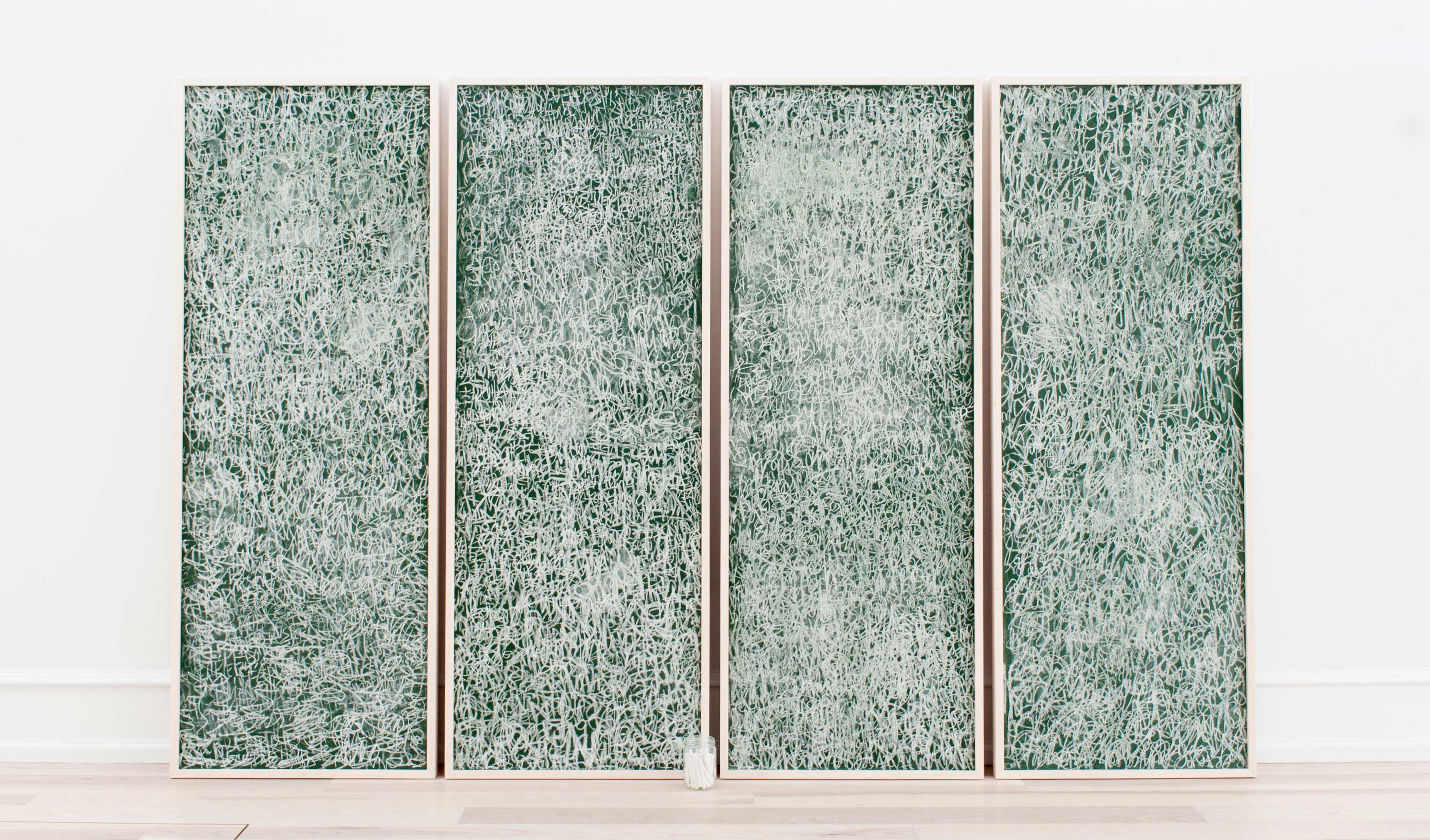
You can qualify by adding your marks or words to Y (2010), a monumental, multi-panel blackboard. Mine would say, “why not?” Using a blackboard as surface and support creates a role reversal in which the visitor/student becomes the artist/teacher, where touching and graffiti are allowed, confessions become public information, and the picture is always impermanent. Words and images are interchangeable, and the work is always both finished and unfinished. Accordingly, the scale and narrow proportions of the panels underscore the physical (as opposed to cognitive) action of markmaking. The height corresponds to the artist’s height and the width of each panel equals that of his extended arm from shoulder to fingertips. For Chang the piece represents “a catharsis, a getting rid of words and thoughts, emptying myself and stop verbalizing everything.”
The same can be said of Chang’s new monochrome paintings in homemade egg tempera whose satin surfaces show nary a brush mark. The surface quality is the result of a labor-intensive process of sanding successive applications (at least three) of chalk and then egg white. If it weren’t for the ragged bottom edge revealing its layered history, the works would not appear to have been painted at all. Despite the medium’s medieval origins, the egg temperas remind me of the perfect monochromatic fields that California Light and Space artists of the late sixties such as John McCracken and Robert Irwin produced—fields that reflected Los Angeles’s clear skies as well as the flawless surfaces of their automobiles and surfboards.
In the works that comprise The Journeyman Chang opens up his practice to different kinds of processes and materials, both traditional—the egg temperas for example—and newfangled. As in postminimalism, or so-called process art of the early 1970s exemplified by the work of such artists as Barry Le Va and Bruce Nauman, Chang’s new work walks a fine line between the intentionality of a set procedure and the physical limits of the operator (artist) and his materials.
In the Appropriations (2011), Chang wrangled a large commercial printing press—for what could be more intentional than a machine? Seeking to undermine the reproduction quality of images of works by Warhol, Munch, and Cezanne among a few others, he reprinted the same sheets (all 1,168 of them) four times using corrosive liquid to corrupt the image. Paradoxically, the resulting splashing and dripping offset ink resembles running paint. Next Chang covered the image with hand-applied graphite and beeswax, further obscuring the image while at the same time physically and symbolically embedding an artistic ancestry in the signature geometry of his work.
Printmaking is one of the principal ways Chang expresses his interest in elaborate technique and layered mediums and the ultimate mystery of their interaction. He embraces the vagaries of chance operations both in the studio and in life, where he assimilates people and opportunities that come his way.
In the series entitled Folds, for example, Chang recuperates scraps of lovely Somerset paper left over from the prints he made at San Francisco’s renowned Crown Point Press into a series of bas-reliefs made by folding the paper, from six down to one time, and displaying them unfolded. Irregularly shaped with deckled or torn edges, some are just a sliver at 1/2" by 12", reminiscent of an archaeological fragment.
The last reproduction in the catalogue is the single fold, Irregular Shape Folded Once, and as Chang pointed out, then you close the catalogue “which is a little folding as well.”
Melissa E. Feldman is an independent curator and writer currently based in the Bay Area, California. A contributor to Art in America, Frieze, and Third Text, among other publications.
Record Summary
- Type
- Catalogue Text
- Published
- Place
- Piedmont, California, USA
- Author
- Melissa E. Feldman
Archive Context
Regarding The Journeyman was written by Melissa E. Feldman in 2011 as a catalogue text accompanying Michael Baastrup Chang’s exhibition The Journeyman.
The text discusses Y (Why), monochrome paintings made in egg tempera, the Appropriations series, and Folds, considering Chang’s use of process, materials, chance, appropriation and systems.
The text is preserved here as an individual archival record within the catalogue texts section of the Michael Baastrup Chang Archive.